Article
The Implementation Gap: Why $5.5B Just Got Bet on the Hardest Problem in AI
OpenAI and Anthropic bet $5.5B combined that AI implementation is tech's biggest opportunity. Getting organizations to actually use AI is the hard part.
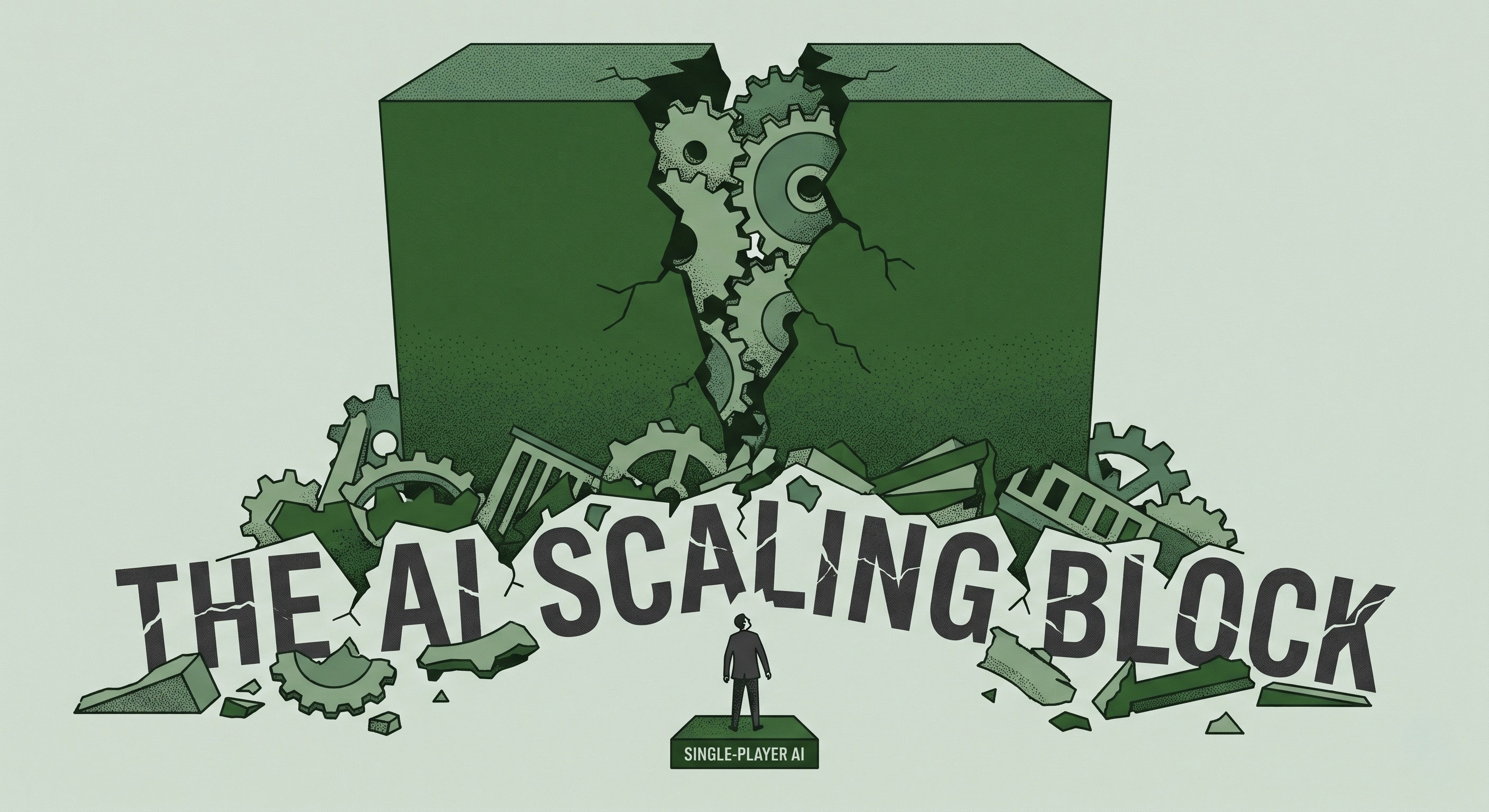
AI works. Getting your company to use it is a completely different problem. OpenAI and Anthropic just bet $5.5B that solving this AI implementation gap is the biggest opportunity in tech right now.
I work at an AI startup on a forward deployed engineering team. I see this gap every single day. Individual users build incredible things with Claude, ChatGPT, and Gemini. They automate workflows, build personal operating systems, and save hours every week. Then you try to roll that same capability out to a team of 50 or 500, and everything falls apart.
The technology is no longer the bottleneck. It hasn't been for at least 6 months. Getting an entire organization to actually use it is the hard part now.
AI Works. For One Person.
Individual AI adoption is a relatively straight-forward problem to solve. Claude, ChatGPT, Gemini. Pick your tool. At the individual level, they all deliver. Productivity gains and faster research across the board. The promise is real when it's one person sitting at their desk building something for themselves.
Power users have taken this even further. They're building personal AI operating systems with markdown files, custom skills, and automated routines. One COO I follow runs a $25M ARR company on what he describes as "a folder of markdown files, Python scripts, and cron jobs." Every morning he gets a doc with priorities, draft replies, and a handoff plan for his AI to work through. It's impressive. It works.
For him.
This is where most companies are right now. A handful of power users doing impressive things. Everyone else using ChatGPT to rewrite emails and summarize meeting notes. The gap between those two groups is enormous, and it's getting wider.
The Single-Player Ceiling
What works for one person breaks at 10. It collapses at 500.
The single-player AI setup lives in someone's head, their local environment, their personal workflow. It can't be handed off or scaled. The person who built it is the only one who can run it and fix it when something breaks. That works when you're a solo operator. It's a problem when you're trying to transform how an organization works.
Notion published an AI Transformation framework that maps this clearly. Four levels:
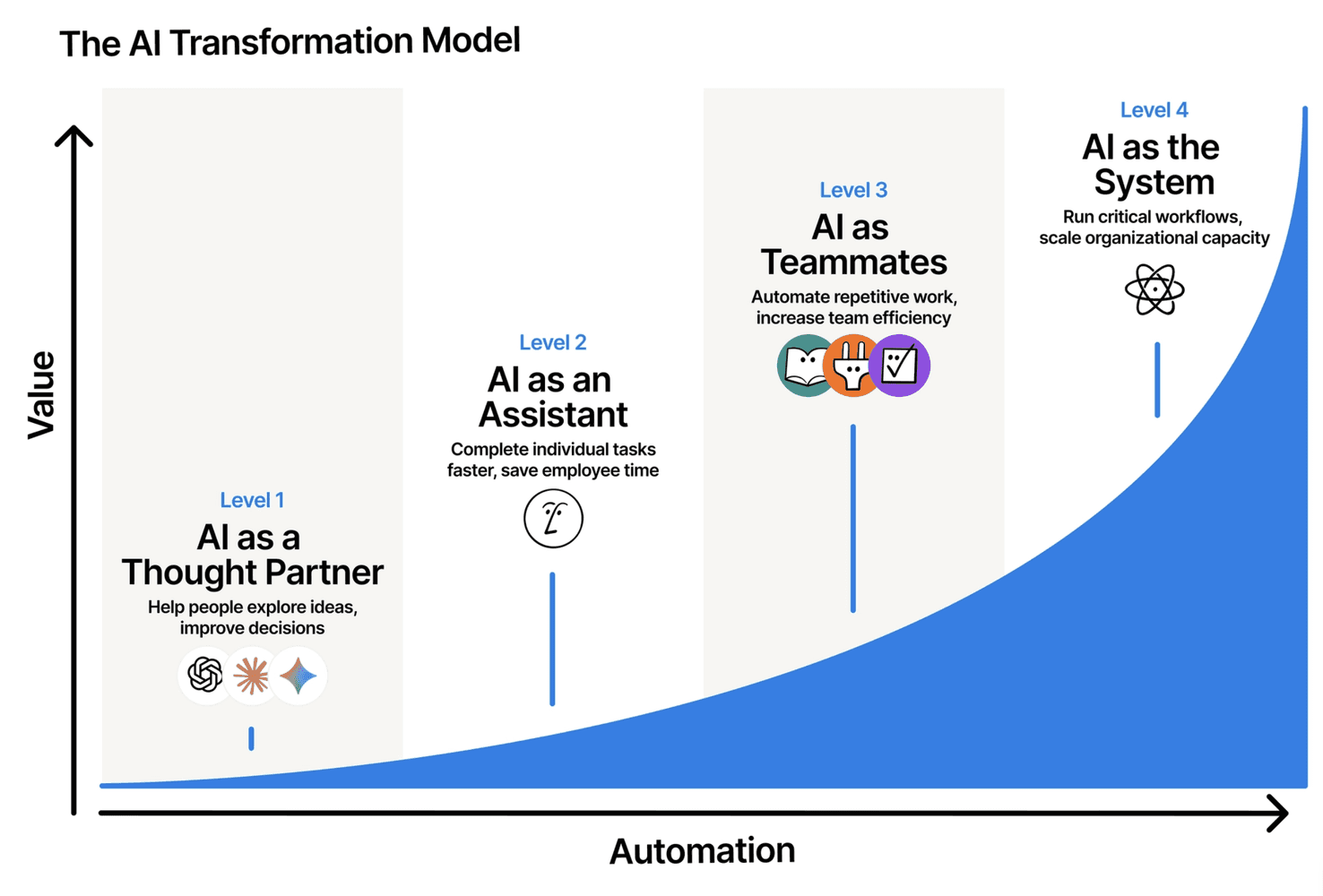
The Notion AI Transformation Model.
Level 1: AI as Thought Partner. People use AI for chat-based exploration and brainstorming. This is where most employees sit today.
Level 2: AI as Assistant. AI is embedded in individual tools. People use it inside their existing workflows, but each person's setup is different.
Level 3: AI as Teammates. AI workflows cross systems and serve teams. Multiple people can use the same AI-powered process. Inputs and outputs are defined.
Level 4: AI as The System. AI runs critical workflows. Humans review exceptions. New hires onboard into AI-augmented processes by default.
Most organizations plateau at Level 1-2. The jump to Level 3-4 is where everyone stalls. Anthropic's own Cowork deployment data across enterprise customers shows the exact same pattern through their five-level model. The blocker is always the same: change management, process documentation, training, and governance. People problems, every time.
I've seen enterprise AI platforms with six-figure contracts sitting at 11-25% utilization. The tool and capability are sitting right there. Nobody's using them. The single-player ceiling is real, and most companies are stuck underneath it.
$5.5 Billion Says This Is the Biggest Gap in Tech
Last week, the two fiercest competitors in AI independently made the same massive bet.
Anthropic partnered with Blackstone, Goldman Sachs, and Hellman & Friedman to launch a $1.5 billion consulting firm. The model: forward-deployed engineers going inside companies to rewire operations around Claude.
OpenAI launched "The Development Company." $4 billion raised at a $10 billion valuation. Partners: TPG, Bain Capital, Brookfield, and Advent International. Same model. Forward-deployed engineers embedding inside businesses.
It's the same business model I've worked at in my last three startups. Hire smart people, sit them down with customers for hours to map their pain. Develop custom solutions on our toolset, and watch the magic happen.
When competitors agree on the same $5.5 billion combined bet, the signal is deafening. Model access is commoditizing. The money is in implementation.
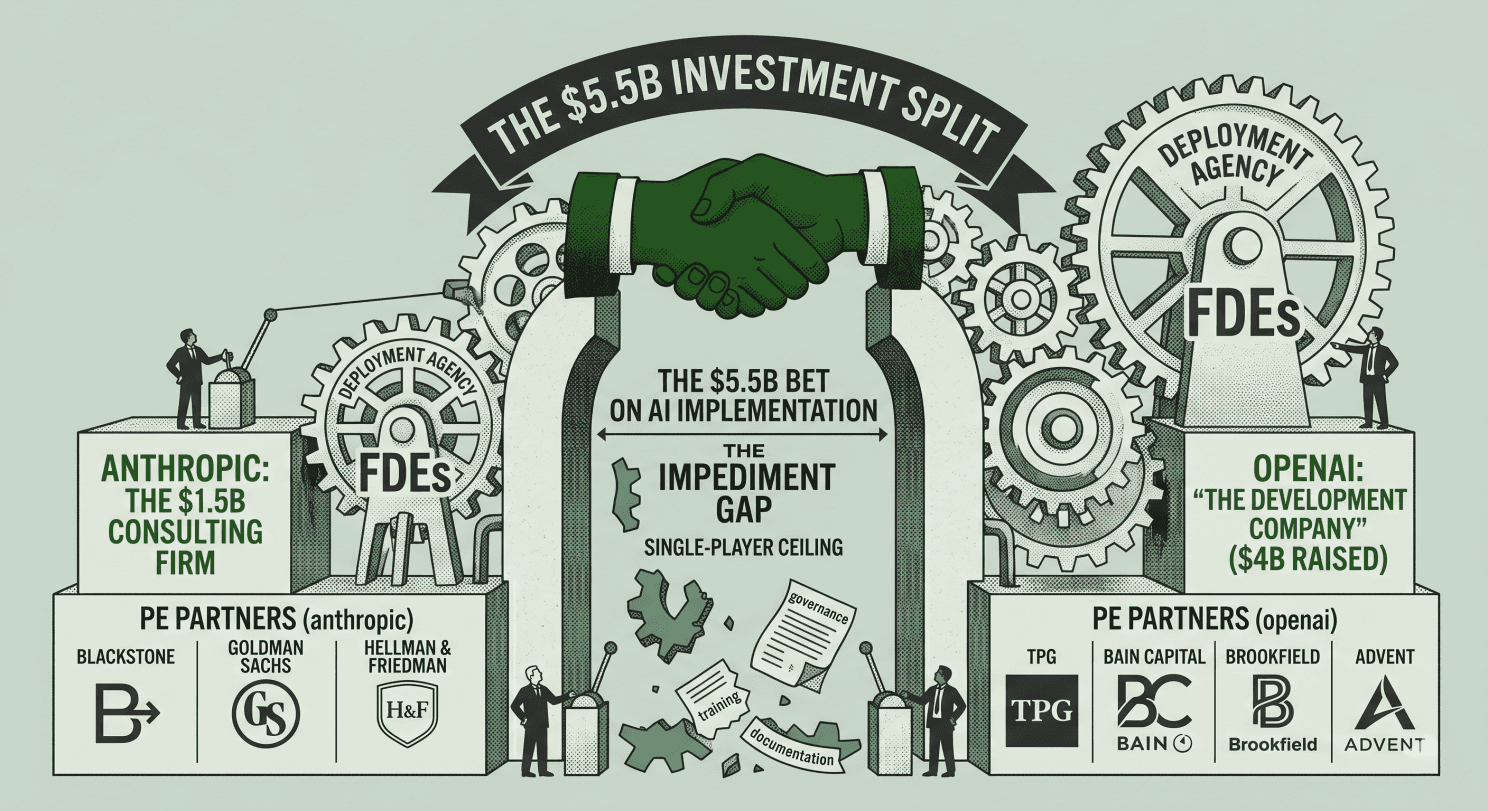
The $5.5B Investment from two of the biggest players in the industry.
The partner selection tells you everything about the distribution strategy. Every single one of those partners is a private equity firm. Blackstone, TPG, Bain Capital, Brookfield, Advent. These companies own portfolios of hundreds of businesses. The play: push AI adoption top-down through the ownership layer across entire portfolios. One conversation with a PE partner opens the door to hundreds of companies.
This is the part I see a lot of peers gloss over. Consultants can recommend all day long, but an owner can mandate it from the board level down. PE firms can mandate adoption plans at their portfolio companies in a way that McKinsey or BCG never could. They can say "every company in our portfolio will implement AI workflows by Q4" and back it with capital, engineering support, and executive pressure from the board level.
This is AI implementation at portfolio scale, not one company at a time. Hundreds simultaneously, pushed through the firms that control the capital.
Goldman's global head of asset management put it plainly: "There's a big shortage of people who know how to apply these tools into businesses and then transform them."
That shortage is what $5.5 billion is chasing.
The Mid-Market Dead Zone
The companies feeling this gap most acutely are doing $2M-$50M a year in revenue. They're past the point where one power user's personal AI setup is enough, but they're nowhere near the size where a Big 4 engagement team or an Anthropic/OpenAI deployment makes sense.
These companies have access to the same AI as Fortune 500 organizations. The models, capabilities, and pricing are identical. But they lack the internal infrastructure, the dedicated AI team, and the change management muscle to actually deploy it across the organization.
Most of them are stuck at Level 1 on Notion's framework. A few individuals experimenting. No shared workflows, no documentation, and no strategy for how AI fits into the way the company actually operates.
This is the market both labs are targeting through their PE partners. It's also where independent operators have the clearest opportunity right now.
Process First, AI Second
Most failed AI rollouts start with "let's use AI for X." The ones that actually work start by asking a different question: "what's broken in this process right now?"
The skill that matters most in AI implementation is knowing which workflows to build. You have to diagnose before you deliver. That means first principles thinking applied to how a business actually operates, not how it thinks it operates.
Every company between $2M and $50M has the same problem:
Access to the best AI ever built, zero clue what to do with it.
The value lives in the person who can walk in, map the operation, find the bottlenecks, and build the system.
There's a line from an AI audit framework that I keep coming back to: "Interviews tell you what people think they do. Shadowing tells you what they actually do. The gap is where 60% of opportunities hide."
That 60% gap is exactly why AI implementation is so hard to do from the outside. You can't just deploy a tool and expect transformation. You have to understand the actual work first, then figure out where AI creates leverage. The companies skipping this step are the ones burning through AI budgets with nothing to show for it.
The Window Is Open
Right now, independent operators and nimble, fast moving companies who can do this kind of work have a structural advantage over the big players. They can iterate faster, get direct access to decision-makers, and deliver ROI in weeks instead of quarters.
YC listed "AI-Native Service Companies" as a top request for startups category. Sequoia republished "Services: The New Software." The market is validating that implementation expertise is the scarce resource.
The window narrows as the labs scale their consulting arms and the Big 4 fully pivot to AI implementation. When Blackstone's portfolio companies have embedded Anthropic engineers and TPG's companies have OpenAI teams on-site, the mid-market will follow. The competitive landscape for AI implementation work will look very different in 18 months.
The operators building this muscle now, the ones learning to map operations, design AI systems, build interfaces non-technical teams can actually use, and iterate against inconsistent model outputs, are positioning themselves for the next 3-5 years.
Single-player AI is a mostly solved puzzle. The game has shifted. The question everyone should be asking: "can you make an organization use AI?"
That's a $5.5+ billion question.