
Case Study
From Spreadsheets to 20-Minute Response Times: How a Seed-Stage Voice Advertising Startup Automated Lead Scoring and Doubled Their Close Rate
This case study details how we rebuilt the client's entire lead capture, enrichment, scoring, routing, and CRM pipeline in 60 days.
Intro
Every startup eventually learns the same lesson: generating leads is only half the battle. If you can't process, qualify, and route those leads fast enough, you're lighting marketing dollars on fire.
Our client, a seed-stage voice advertising startup, was processing 200+ inbound leads per week. Their system for handling those leads was email notifications, spreadsheets, and a HubSpot instance with a single lead stage. Three people spent their days manually copying form submissions into the CRM, researching prospects by hand, and hoping nothing fell through the cracks.
Things fell through the cracks.
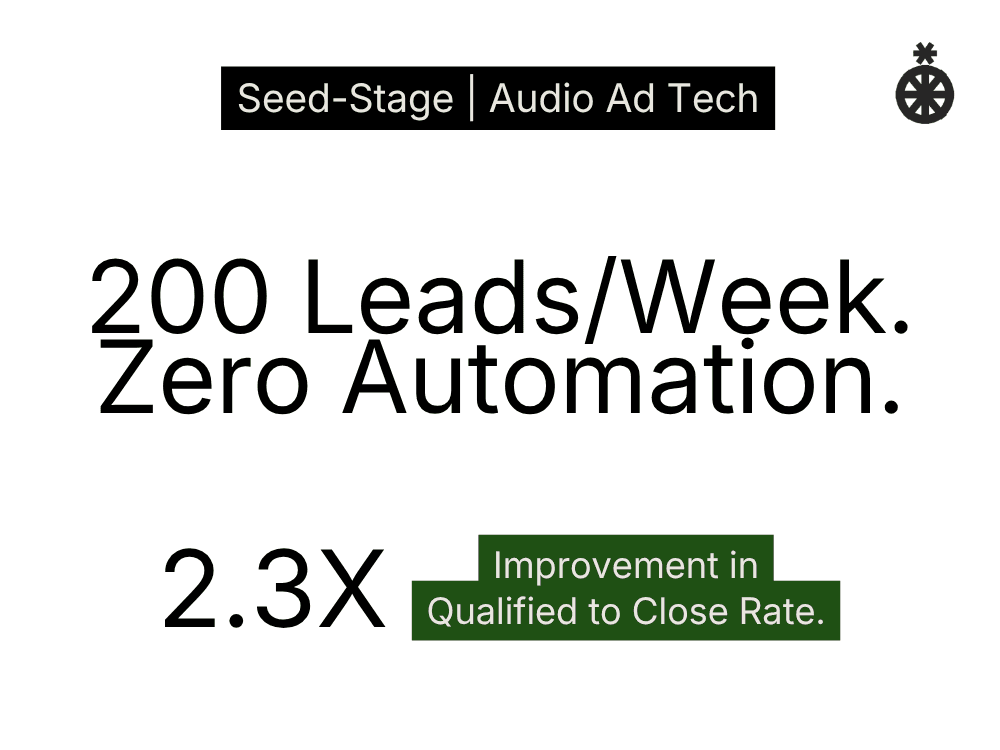
This case study details how we rebuilt the client's entire lead capture, enrichment, scoring, routing, and CRM pipeline in 60 days. The results: 20 hours of manual work eliminated per week, lead response times cut from 48+ hours to under 20 minutes, and qualified-lead-to-close conversion rates improved from 2% to 4.5%.
The Challenge: Manual Everything at 200 Leads Per Week
The client operates in voice advertising, serving audio ads across multiple publisher sites. With a lean team of 18, they were punching above their weight on the product side. Their go-to-market infrastructure told a different story.
The Manual Processing Tax
Every lead that came through the website or a lead magnet followed the same painful path:
A form submission triggered an email notification
Someone on the sales team manually reviewed the submission
That person would then go into Apollo and Prospeo to research and validate the lead's email, company, and role
They'd manually enter the enriched data into HubSpot
The lead would land in a single, undifferentiated stage where all leads sat together regardless of quality
Each lead took an average of 7 minutes to process. At 200 leads per week, that's roughly 23 hours of manual work spread across three team members. The BDRs and AEs who should have been selling were instead doing data entry.
No Scoring, No Routing, No Structure
HubSpot had one lead stage. Every lead, whether it was a VP of Media at a major publisher or someone who accidentally filled out a form, ended up in the same bucket. There was no scoring logic, no qualification criteria, and no routing rules. Which AE got which lead was essentially random.
The pipeline itself had no gating. AEs moved deals through stages at their own discretion with no required fields, no completion criteria, and no consistency across the team. Each rep managed their pipeline differently, which meant leadership had no reliable view into deal health or forecast accuracy.
The Breaking Point
When a marketing push generated a surge in inbound volume, the manual system buckled. Leads piled up faster than the team could process them. Response times stretched past 48 hours. By the time a rep reached out, prospects had gone cold or moved on to a competitor.
The team was leaving deals on the table because they physically could not process the volume their marketing was generating. The system that worked at 50 leads per week was failing at 200.
The Solution: An Automated Revenue Pipeline
Partnering with Fortuna, the client rebuilt their lead infrastructure from form submission to closed deal. The 60-day engagement covered four major workstreams, followed by a 3-month maintenance retainer to tune and stabilize the system.
Phase 1: Automated Lead Capture and Enrichment
The first priority was eliminating the manual enrichment bottleneck.
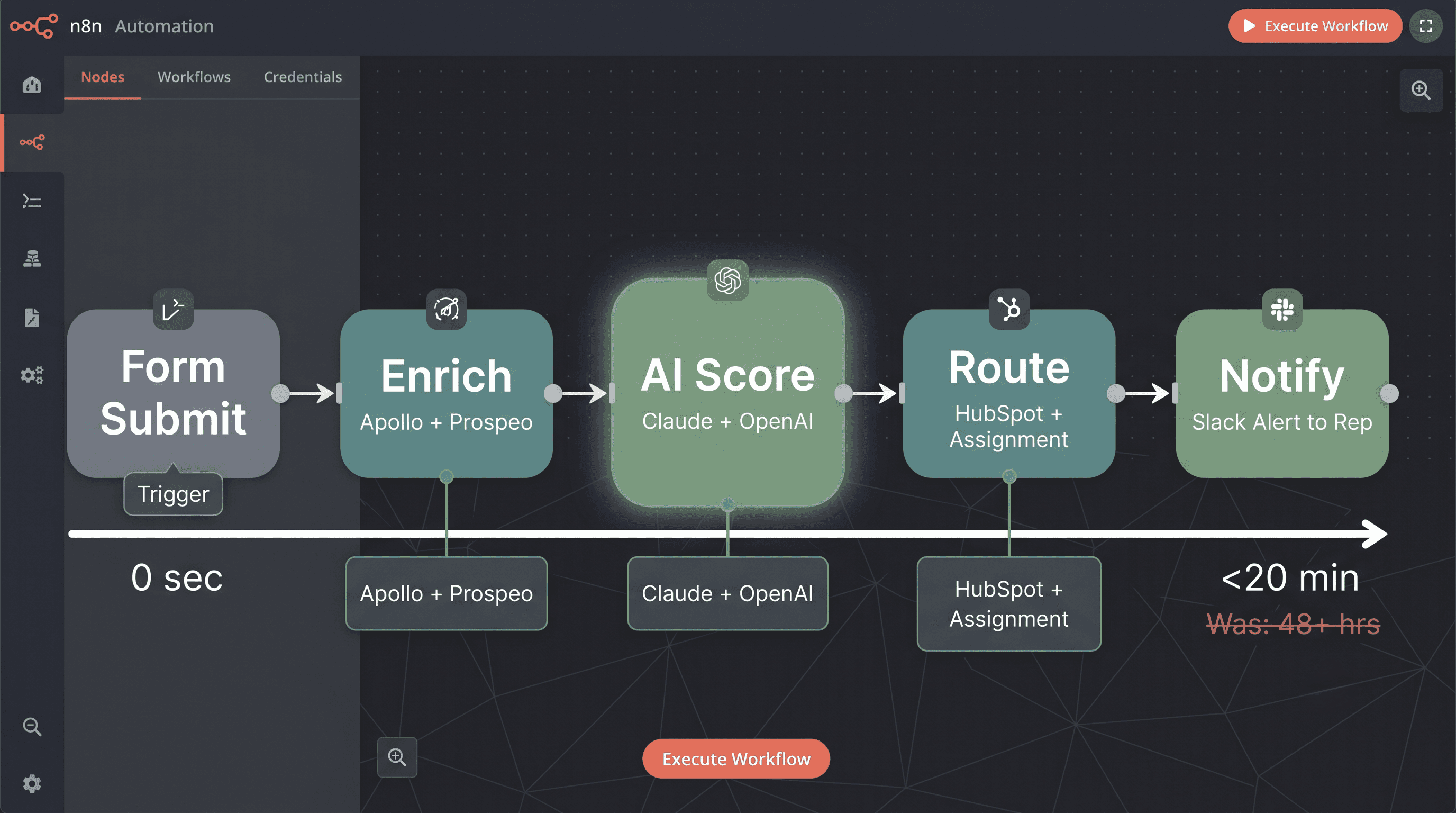
We configured HubSpot Forms as the primary capture mechanism across the website and lead magnets. When a form submission came in, the lead immediately entered an automated enrichment pipeline built on n8n.
The n8n workflow handled the enrichment in two steps:
Apollo pulled company data, firmographic details, contact information, and role context for the lead
Prospeo validated the email address and cross-referenced the associated information for accuracy
No human touched the lead during this process. What previously took 7 minutes of manual research per lead now happened in seconds.
Phase 2: AI-Powered Lead Scoring
With enriched lead data flowing automatically, we built a scoring engine inside n8n that evaluated each lead on multiple dimensions.
Scoring signals included:
Company and industry fit. Leads from companies in media, publishing, and advertising verticals scored higher based on the client's target market
Job title and seniority. Decision-makers and budget holders received priority scoring over individual contributors
Media buying history. Using Claude and OpenAI, the system searched the web for evidence of previous media buys associated with the lead's company. If the AI models found signals of active ad spend or programmatic buying activity, that significantly boosted the lead's score
The AI research step was the differentiator. Most lead scoring systems rely on static firmographic data. Amplift's system actively investigated whether a prospect had buying history relevant to voice advertising, giving the sales team a qualification signal that would have taken 15-20 minutes of manual research per lead.
Phase 3: Automated Routing and Notifications
Scored and qualified leads flowed directly into HubSpot with complete profiles, scores, and AI research notes attached. The routing logic then assigned leads based on AE bandwidth. Reps with lighter pipelines received more new leads, while reps handling heavy deal volume were protected from overload.
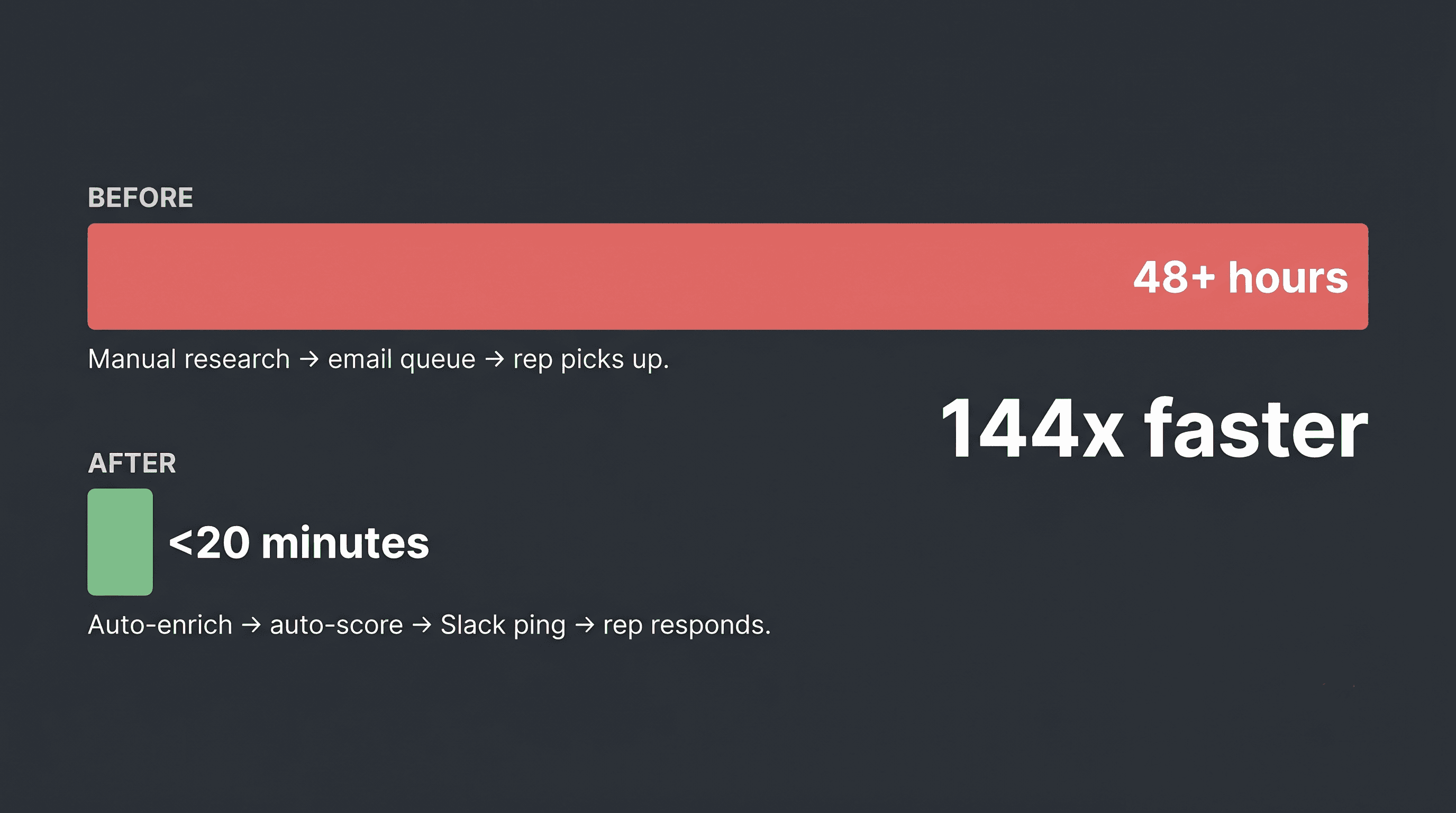
When a lead was assigned, the rep received an instant Slack notification with the lead's details, score, and enrichment summary. No more checking email queues. No more leads sitting unnoticed for days. The average response time went from over 48 hours to under 20 minutes.
Phase 4: CRM Rebuild and Pipeline Gating
The HubSpot instance needed structural work. We replaced the single lead stage with a full-lifecycle pipeline:
Lead (raw inbound)
MQL (marketing qualified, meets basic scoring threshold)
SQL (sales qualified, confirmed fit after initial outreach)
Hot Lead (active buying signals, high engagement)
Conversation (discovery call completed)
Offer (proposal delivered)
Negotiation (terms being discussed)
Closed Won / Closed Lost
Each stage had gating criteria with specific items that needed to be completed before an AE could move a deal forward. This prevented the old pattern of reps dragging deals through the pipeline without proper qualification, and gave leadership accurate visibility into where deals actually stood.
Phase 5: CRM Hygiene and Data Cleanup
The existing HubSpot data was inconsistent. Duplicate contacts, duplicate opportunities, and no standardized data conventions across the team.
We ran a deduplication pass across contacts and opportunities, then restructured the data model so that all information flowing in from the automated pipeline landed in the right fields with the right formatting. The cleanup ensured that the new automated workflows were building on a clean foundation rather than layering automation on top of messy data.
The Results: From Data Entry to Deal Closing
The transformation delivered measurable impact across the team's capacity, their responsiveness to leads, and their close rates.
20 Hours of Manual Work Eliminated Per Week
The automated enrichment, scoring, and routing pipeline replaced the work of three people who had been manually processing leads. Those 20+ hours per week went back to the BDRs and AEs for selling. No additional headcount was needed to handle the same lead volume.
Lead Response Time: 48+ Hours to Under 20 Minutes
The combination of instant enrichment, automated scoring, and Slack notifications meant leads were in a rep's hands within minutes of submitting a form. The team could now handle volume surges from marketing pushes without leads piling up or going cold.
Conversion Rate: 2% to 4.5% (Qualified Lead to Closed Won)
The scoring engine filtered out unqualified leads before they reached a rep, and the AI-powered research surfaced buying signals that helped reps prioritize the right prospects. The gated pipeline ensured deals were properly qualified at each stage.
The result was a 125% improvement in the qualified-lead-to-close rate. Reps were spending their time on better leads with better information, and the structured pipeline kept deals from stalling or slipping through.
System Resilience
Marketing surges that previously overwhelmed the team now processed automatically. The system handled 200+ leads per week without human intervention in the enrichment and routing stages, and could scale to significantly higher volumes without adding headcount.
Conclusion: Automation Compounds When You Build the Full Pipeline
The lesson from this engagement is that automating one piece of the lead pipeline doesn't move the needle. The value comes from connecting the entire chain: capture, enrichment, scoring, routing, CRM structure, and pipeline discipline.
Automating enrichment alone would have saved some time. Automating routing alone would have improved response times. But connecting all of it, and adding AI-powered research to the scoring logic, created a compounding effect where every improvement amplified the others.
The client's sales team didn't change. Their tools didn't fundamentally change. What changed was the system connecting those tools and the intelligence layered on top of the data flowing through them.
At Fortuna, we engineer GTM systems that turn manual processes into automated pipelines, so your team can focus on closing deals instead of copying data between spreadsheets.
"We went from dreading marketing pushes because we couldn't keep up, to welcoming them. The system handles the volume, scores the leads, and puts the best opportunities in front of our reps before the prospect has time to forget they reached out."
Head of Ops