
Case Study
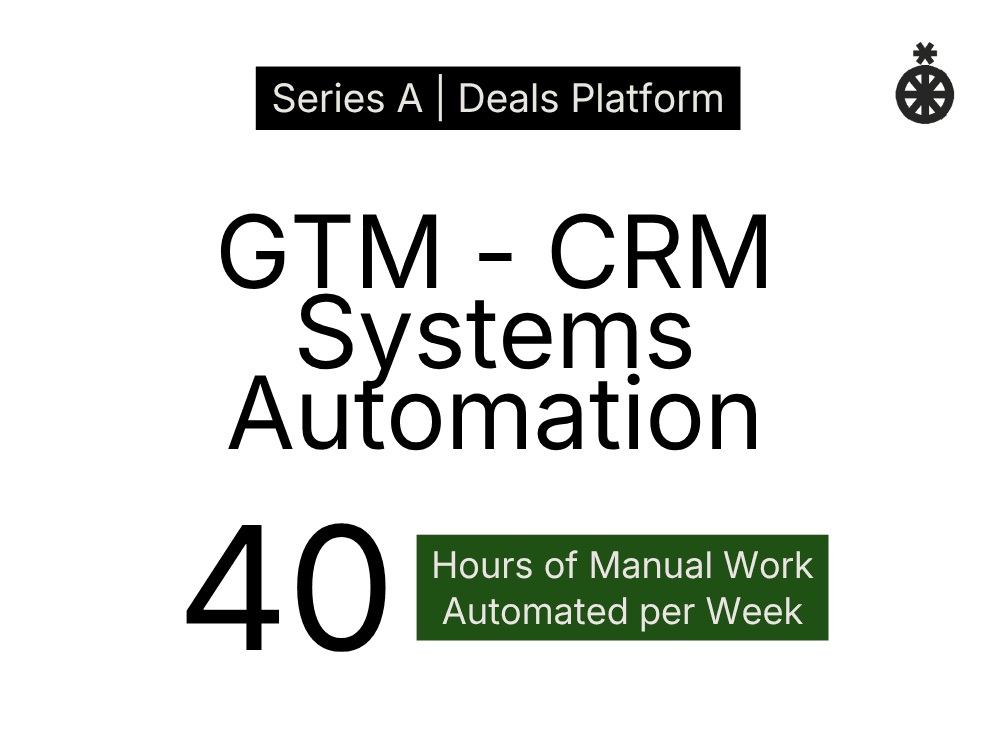
How We Eliminated 40 Hours of Weekly CRM Busywork and Boosted Conversions by 26%
Scaling an early stage startup is a race against operational chaos. A Series A digital deals platform was winning on the revenue front but losing ground internally. Their 8-person sales team was trapped in a cycle of manual CRM updates, scattered data, and inconsistent processes.
Intro
Sales reps spent 5 hours per week on administrative busywork instead of closing deals.
This white paper details how we:
Engineered a unified sales operating system in 9 weeks,
Eliminated 40 hours of weekly manual work,
Boosted conversion rates by 26%, and
Systematized 30+ critical processes.
The transformation turned their sales team from data entry clerks back into revenue generators.
The Challenge: When Growth Creates Gridlock
The company's growth was their biggest strength, and their biggest operational liability.
As their sales team expanded to 8 reps, the cracks in their GTM infrastructure became chasms. The team operated across multiple disconnected tools: HubSpot for CRM, Apollo for enrichment, Gmail for outreach, Slack for notifications, and Notion for task management.
None of them talked to each other.
The Manual Tax
Every lead required manual work:
Data entry redundancy: Reps manually enriched leads, copied data between systems, and updated multiple tools
Manual lead routing: New leads sat in a queue waiting for manual assignment and qualification
Inconsistent follow-up: Reps manually sent follow-up emails through Gmail with no systematic process
No lead scoring: Qualification was gut feel, not data-driven
The cost added up to 5 hours per rep per week. Across 8 reps, that's 40 hours of lost selling time weekly. The equivalent of a full-time employee doing nothing but copying and pasting.
The Conversion Problem
But the real damage was lost revenue.
Long delays in lead response times meant hot prospects went cold. Inconsistent qualification at the top of funnel meant reps chased low-value leads while high-value opportunities languished.
The sales funnel was a black box, leadership had no visibility into where deals stalled or why.
The company needed systems engineering.
The Solution: Engineering Sales Intelligence
Partnering with Fortuna, the client rebuilt their GTM infrastructure from the ground up. We worked closely together to architect an automated revenue engine.
Week 1: Systems Audit & Discovery
Before building anything, we mapped the reality on the ground.
We shadowed the sales team, documented every manual step, and identified bottlenecks in the data flow. The audit revealed 30+ manual processes that could be automated, from lead routing to follow-up sequences to pipeline reporting.
The team wasn't doing this manual work because they wanted to. They were doing it because the system gave them no choice.
Weeks 2-4: Building the Automated Revenue Engine
We built n8n as the central nervous system connecting Apollo, HubSpot, Gmail, Slack, and Notion. Every data flow that previously required human intervention became automatic.
Automated Lead Enrichment Pipeline
New leads from the website were automatically sent to Apollo for enrichment, pulling in company data, contact details, and firmographic information.
Enriched leads then flowed directly into HubSpot with complete profiles—no more manual research or data entry.
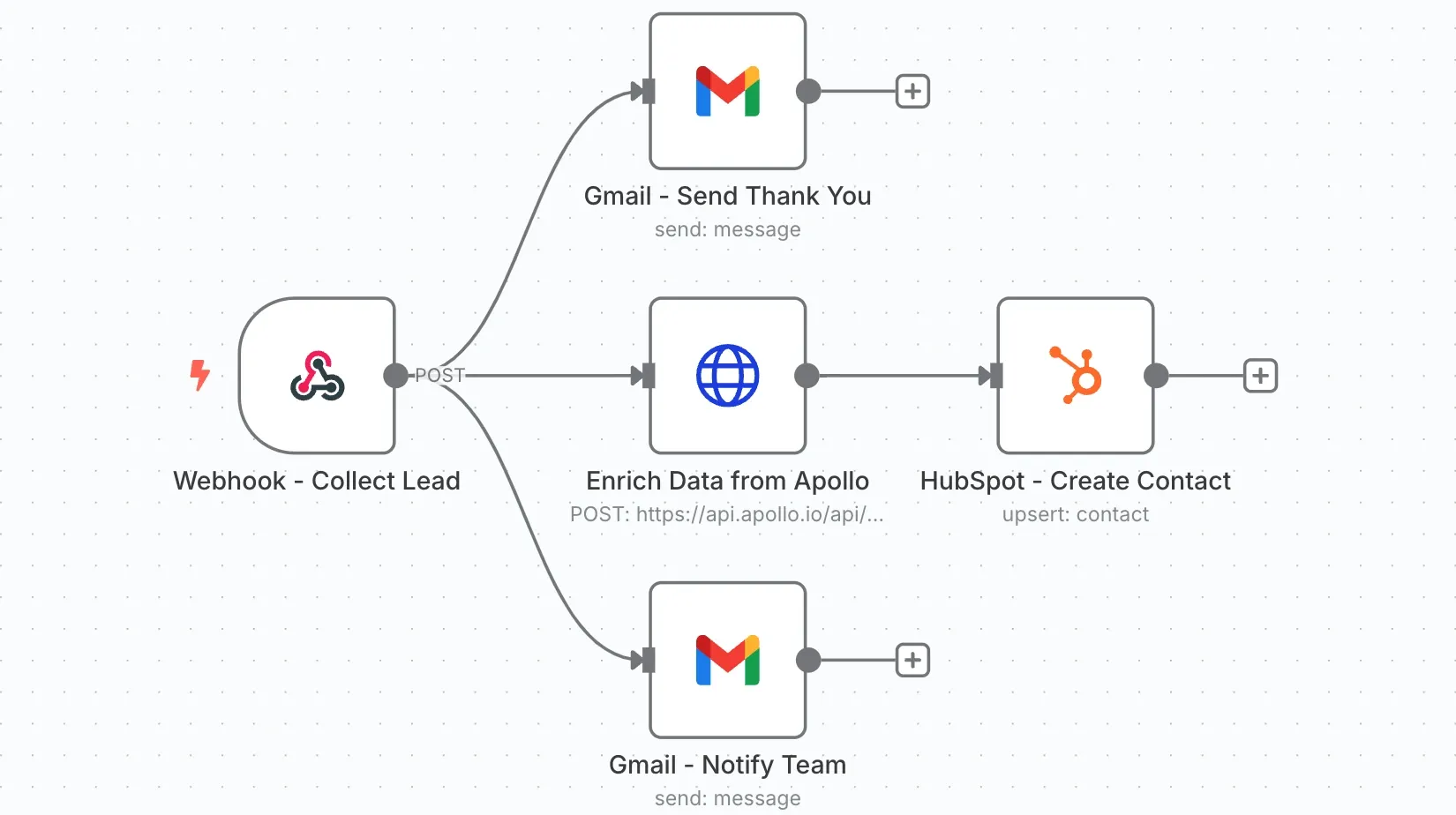
Instant Lead Routing & Notifications + Automated Follow-Up Sequences
Once enriched leads hit HubSpot, they were automatically scored, qualified, and assigned to the right rep based on territory, product fit, and workload.
Reps received instant notifications via Slack with lead details and next actions. No more manual queue review. No more "I didn't see that lead until 3 days later."
When a deal in HubSpot moved stages, n8n automatically triggered personalized follow-up emails through Gmail, logged the activity back to HubSpot, and created follow-up tasks in Notion.
No more forgetting to follow up. No more manual email sends.
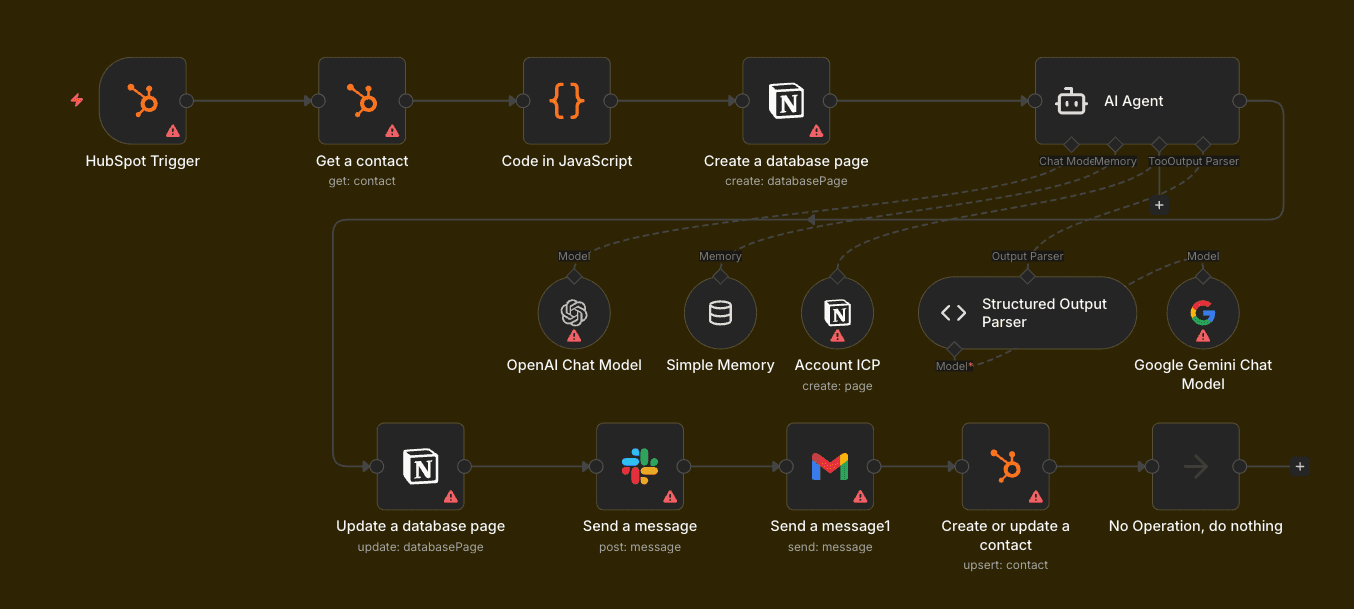
Lead Scoring System With Zero Manual Data Entry
We built an automated lead scoring engine that analyzed engagement, company size, and behavioral signals to surface the hottest opportunities.
High-scoring leads got instant attention and immediate rep assignment. Low-scoring leads got automated nurture sequences.
Data flowed automatically through the entire pipeline: Lead intake → Apollo enrichment → HubSpot → Gmail outreach → Slack notifications → Notion task management.
Update a contact in HubSpot? It instantly appears in Notion.
Send an email? It logs in HubSpot. The single source of truth was distributed—but automated.
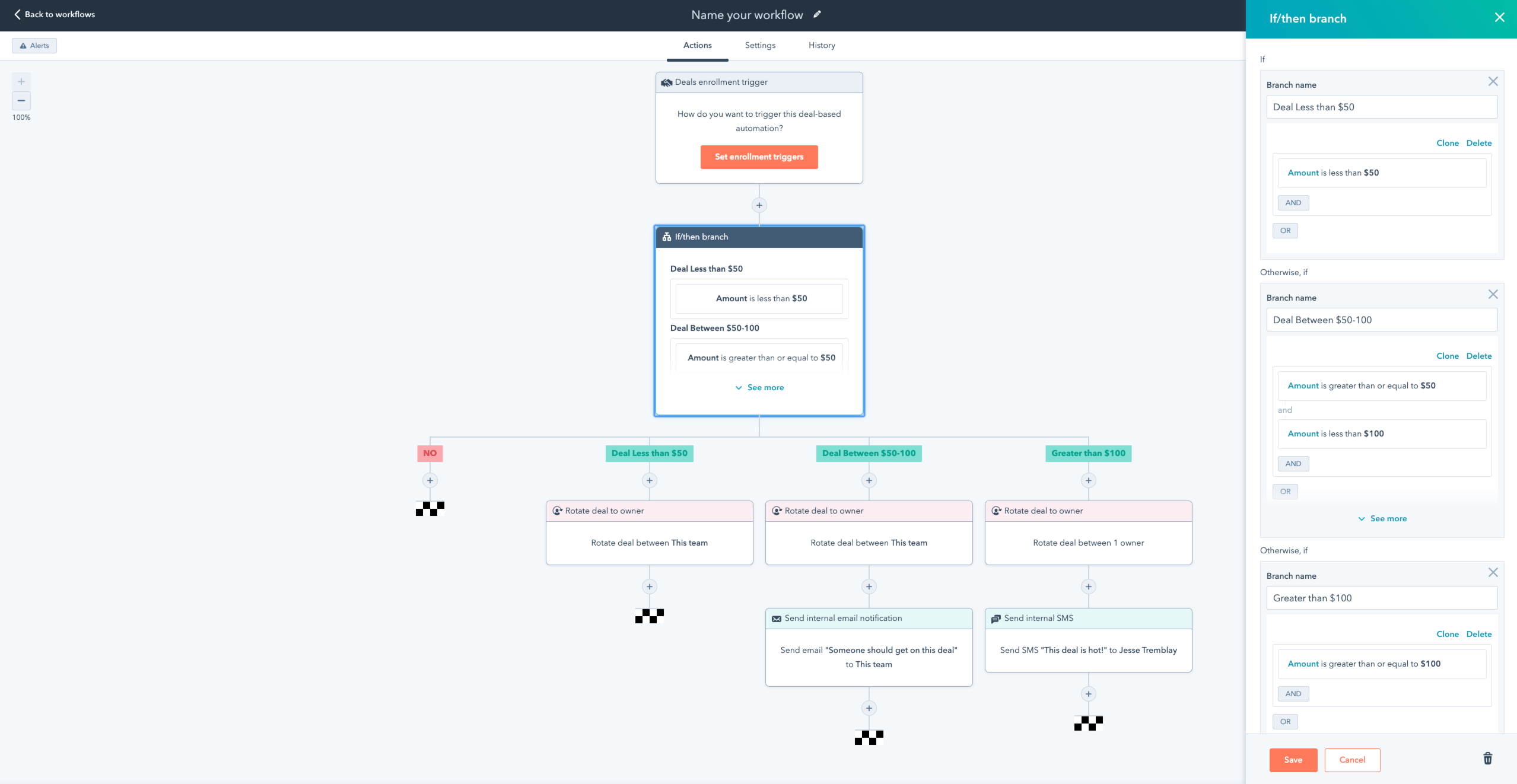
Weeks 5-6: Refinement & Optimization
Automation isn't "set it and forget it." We spent two weeks tuning the system based on real-world usage.
We refined lead routing rules as the team gave feedback on assignment logic. We optimized the lead scoring model to reduce false positives. We adjusted follow-up timing based on response rate data.
The system evolved from working to working well.
Weeks 7-8: Operationalizing Knowledge
The final piece was making knowledge durable.
We documented 30+ sales processes as SOPs and embedded them directly into the workflows. When a rep opens a task in Notion called "Send Proposal," the SOP for how to send a proposal is right there—no hunting through dusty wikis or Slacking teammates.
We trained the team on the new automated workflows and handed off living documentation. The system worked, and the team could maintain it independently.
The Results: From Admin to Revenue Focus
The transformation delivered immediate, measurable impact.
40 Hours/Week Reclaimed
By eliminating manual data entry, redundant updates, and manual lead routing, we freed up 40 hours per week across the team. That's the equivalent of adding a full-time AE to the roster—without hiring.
Sales reps went from spending 5 hours a week on CRM hygiene to spending those hours on calls, demos, and closing deals.
26% Lift in Conversion Rates
The combination of instant lead routing, automated follow-up, and smart lead scoring drove a 26% improvement in conversion rates.
Speed made the difference. Leads contacted within 5 minutes convert at 9x the rate of leads contacted after 30 minutes. The automated system eliminated those delays.
Qualification mattered just as much. The lead scoring system ensured reps focused their energy on prospects actually likely to buy, not tire-kickers.
30+ Processes Systematized
Knowledge no longer lives in people's heads. The 30+ documented and automated processes mean:
New reps ramp faster (they follow the playbook, not tribal knowledge)
Quality is consistent (everyone follows the same process)
The business is resilient (if someone leaves, their process doesn't)
The sales team is now a system, not a collection of individual operators.
Conclusion: Systems Beat Willpower
The lesson from this engagement is simple but profound: You can't "try harder" your way out of manual processes.
Asking your sales team to "be more disciplined about CRM updates" is a losing battle. Human willpower will always lose to system friction. Better systems solve this. Better people don't.
Tools alone don't solve the problem. Buying HubSpot, Apollo, Gmail, Slack, or Notion doesn't magically create efficiency. In fact, disconnected tools often create more chaos, not less.
Systems engineering is what works. Architect the data flows. Automate the handoffs. Make the right action the easiest action.
At Fortuna, we engineer your business for scale.
"Our sales team went from drowning in CRM busywork to focusing on what they do best: closing deals. The automated workflows freed up the equivalent of a full-time employee, and our 26% conversion lift speaks for itself."
— Senior Sales Manager, Client Company
Ready to Automate Your Workflows?
Is your team struggling with similar challenges? Are you looking to streamline your processes, reduce costs, and boost productivity?
When you’re ready, I can help you:
I’m Mike - a systems builder and startup expert.
I help early stage startups manage and optimize their operations with simple, scalable systems - built using tools like Notion, Slack, and n8n.