Article
How We Used AI to Build a Training Program That Customers Actually Need
How do you build a training program that actually addresses what customers struggle with?
Most companies build training based on what they think customers need to know. Product features, platform walkthroughs, setup guides. All useful, all necessary. But often completely disconnected from the actual moments where customers get stuck.
How do you build a training program that actually addresses what customers struggle with?
Most companies build training based on what they think customers need to know. Product features, platform walkthroughs, setup guides. All useful, all necessary. But often completely disconnected from the actual moments where customers get stuck.
The gap between what you teach and what people struggle with is where adoption dies. I wanted to close that gap, so I tried a different approach.
Let the Customers Tell You
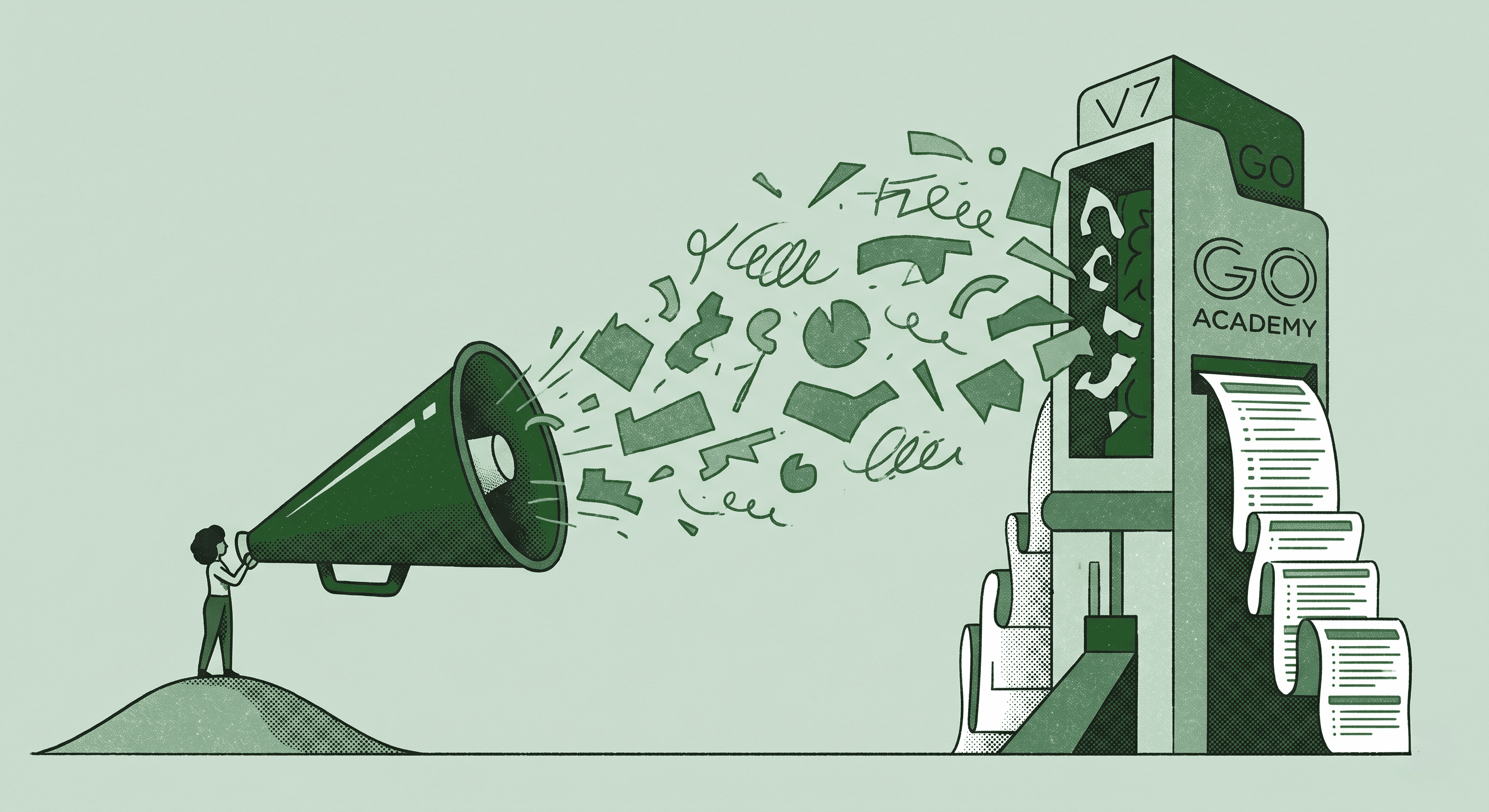
Instead of guessing which topics to cover, I built an AI agent that analyzes every client call we've had. The agent reviews conversations, extracts the exact moments where confusion surfaces, identifies repeated questions across multiple clients, and drafts lesson outlines ranked by impact.
The insight isn't just which topics come up. It's which topics come up repeatedly across different customers at different stages. Those are the real gaps in your enablement.
When you see the same question asked ten different ways by ten different clients, that's not a training problem. That's a product communication problem. And the training program is your best lever to fix it.
How We Built Go Academy This Way
We used V7 Go to build out Go Academy based directly on our client call data. The process was straightforward.
The agent ingested transcripts from client calls over several months. It flagged confusion moments, which are the points in a conversation where a customer asks for clarification, expresses frustration, or misunderstands a concept. It grouped those moments by theme and ranked them by frequency and severity.
From there, it drafted lesson outlines for each theme. The outlines weren't perfect out of the box, but they gave us a structured starting point that was grounded in real customer pain, not internal assumptions.
The result was a training program built on evidence rather than intuition.
Why This Approach Works Better
Traditional training programs are built inside-out. The product team decides what's important, writes documentation, and hopes customers find it useful.
This approach is outside-in. You start with the customer's actual experience and work backward to the content that would have prevented their confusion.
The difference shows up in adoption. When training content directly addresses the thing a customer was struggling with yesterday, they engage with it. When it covers features they haven't encountered yet, they skip it.
Applying This to Your Own Business
You don't need to be building a formal academy to use this approach. If you're running a startup with any kind of customer-facing team, you're sitting on a goldmine of insight in your call recordings.
Start simple. Pick your last 20 client calls. Look for the moments where customers ask clarifying questions or express confusion. Group those moments by theme. Build your FAQ, onboarding guide, or help documentation around the themes that come up most frequently.
If you want to take it further, an AI agent can do this analysis at scale. It can process hundreds of calls and surface patterns that no human would catch by listening to recordings one at a time.
The best training programs don't teach what you think is important. They teach what your customers are telling you they need.