
Article
One Hire That Unlocks 20x: Why Your Next GTM Investment Is a Seller Who Builds
What used to take 10 SDRs now runs on 2 people. One GTM Engineer handling ingestion, enrichment, scoring, sequencing, and outcome capture. One Content Engineer handling asset creation, distribution, engagement, and signal routing.

The math on your next GTM hire just changed and now the question is whether you're hiring for one headcount of output, or for someone who can unlock 20x from the team you already have.
The Compression Math
Today a GTM Engineer paired with a Content Engineer can replace 10 SDRs. The two roles feed each other in a reinforcing loop, where content pre-warms accounts so outbound converts higher. Engagement signals feed back into lead scoring and the whole system compounds.
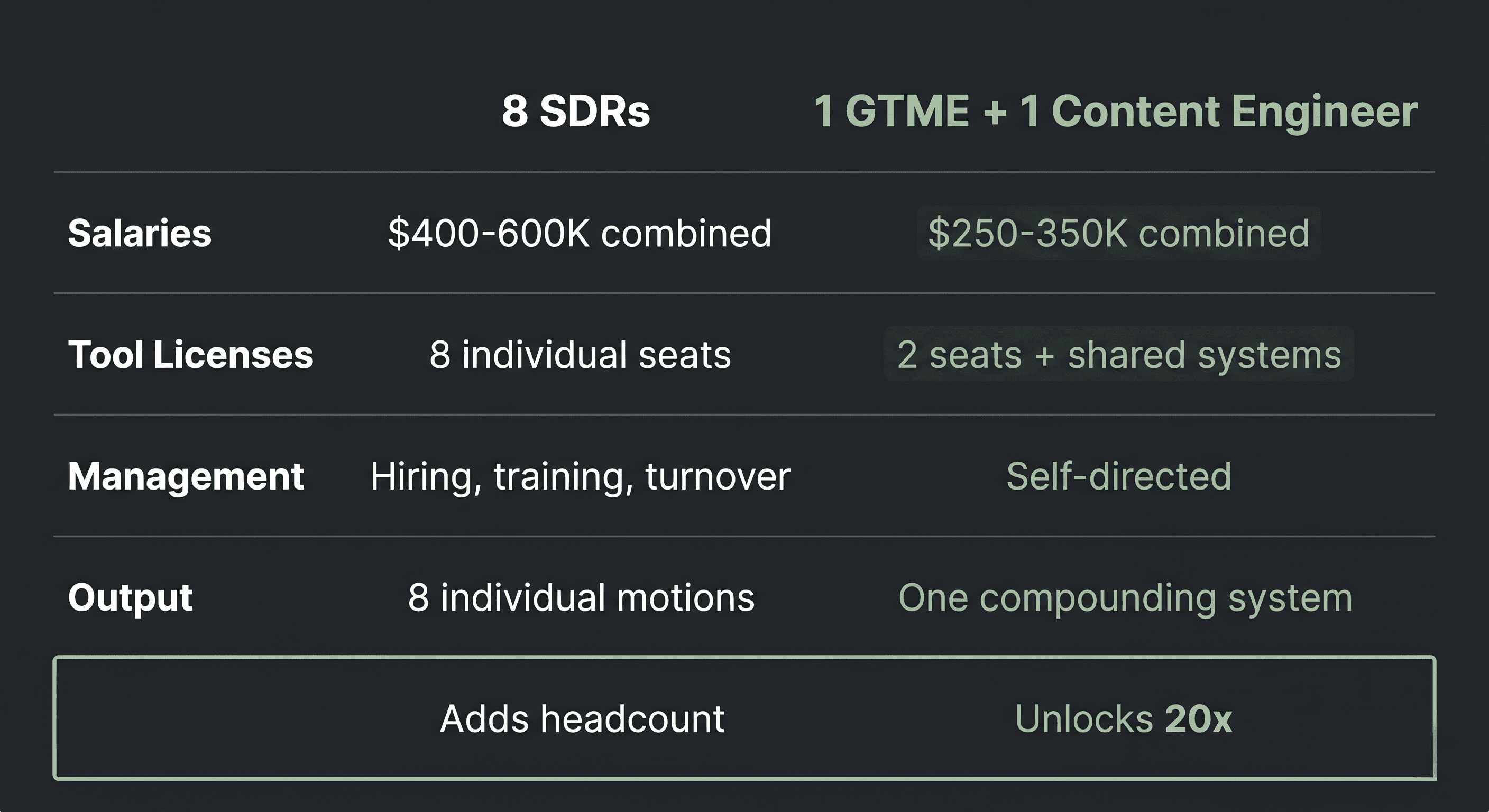
The instinctive reaction is sticker shock, GTM Engineer compensation is running $250K-650K OTE. That sounds expensive until you line it up against the alternative: 8 SDR salaries, their tool licenses, their management overhead, their ramp time, and the inconsistency of 8 different people running 8 different versions of the same outbound motion.
The 2 people didn't do the work of 10 by working harder. They built systems that made the work of 10 unnecessary. That's capability multiplication. Jacob Tuwiner's Pipeline OS generated $1.5M in pipeline using a dual-scoring model (Fit x Timing = Priority) that pushes a ranked queue into HubSpot. Varun Anand ran a signal-first ABM campaign at Clay for $5,280 total and expects roughly 100x in pipeline-to-spend ratio. These are systems that run after you build them. Every SDR you add runs until they leave.
Why the Seller Who Builds Is the Highest-Leverage Hire
Jared Sires was an AE at Anthropic managing 600-700 accounts. 10-15 calls a day, emails until 10pm, answering the same questions over and over. He was drowning.
So he built a tool to save himself. CLAFTS (Claude Drafts), a Gmail integration that drafts personalized emails using Claude. Zero coding experience before starting. Claude Code wrote almost all of the ~4,300 lines. Hundreds of system prompt iterations to match his voice. It saved him 10-15 hours a week.
The hard part was knowing what to build. Sires lived the pain of 700 accounts and an unmanageable inbox. The solution quality came from the problem specificity, he didn't sit in a meeting and brainstorm what sellers might need. He was the seller. He knew exactly what was eating his time because it was eating his time right now.
This is the hiring lens that most founders get wrong. They post an engineering job req when they need a seller with builder instincts. The technical barrier dissolved, AI coding tools like Claude Code eliminated it entirely. The ability to connect with people, understand the implications of the problems they're facing, and see the downstream impacts on the business still requires a human. That's the massive value add. Empower those people with AI, automations, and systems, and you unlock 20x+ productivity gains from your top performers.
The bottleneck is domain expertise, but the technical execution is free.
The 80% Adoption Signal
80% of Anthropic's sales team adopted Sires' tools within months. Most internal tooling dies at 10% adoption. Someone builds something clever, sends a Slack message about it, and three weeks later nobody uses it.
Sires' tools stuck because he built from his own pain. The tools solved problems he experienced every single day.
Two anchor skills proved value immediately:
/customer-context pulls a 360-degree account view across Salesforce, Intercom, Gong, Calendar, Gmail, Drive, and BigQuery in about 90 seconds. One command pulls from seven data sources into a complete picture.
/pipeline-management surfaces at-risk deals, forecasting guidance, and progression recommendations. Instead of scrolling through a CRM and trying to pattern-match which deals need attention, the system tells you.
Both solve universal seller problems: "Where should I focus today?" and "What do I need to know before this call?" Every seller asks these questions every morning. Sires just built the system that answers them automatically.
Distribution happened through Claude Cowork plugins. Anyone on the team installs in minutes. The remaining 20% who hadn't adopted were new hires, and the plugin was specifically designed to help them ramp faster.
The Career Path Is Real Now
The career data behind this role is concrete.
Daniel Chepenko published the first data-backed analysis of who actually becomes a GTM engineer.
Five roughly equal entry paths. Sales at 23%, marketing and growth at 22%, engineering and data at 18%, founders and execs at 17%, ops and RevOps at 14%. No single background dominates. You don't need to be a former engineer.
This is a mid-career move. 91% have 3 or more prior jobs, with a median of 8 previous roles. People transition into GTM engineering after years of building domain expertise in adjacent roles.
The market has moved. 54% of high-growth companies now have the GTM engineer role. Compensation at neoclouds is running $250K-650K OTE. Clay built a dedicated program called AlphaForge specifically to produce GTM engineers and place them in companies that need the role filled. I'm enrolled in the second cohort right now.
Alex Lindahl pushed the trajectory further with the Forward Deployed Engineer thesis. FDEs deploy AI solutions directly inside customer environments. These roles are appearing at every stage: Watt at seed, Clay at growth, Salesforce at enterprise. Palantir pioneered the model years ago. The difference now is that AI tools made it accessible to people without engineering backgrounds.
What This Actually Looks Like Day-to-Day
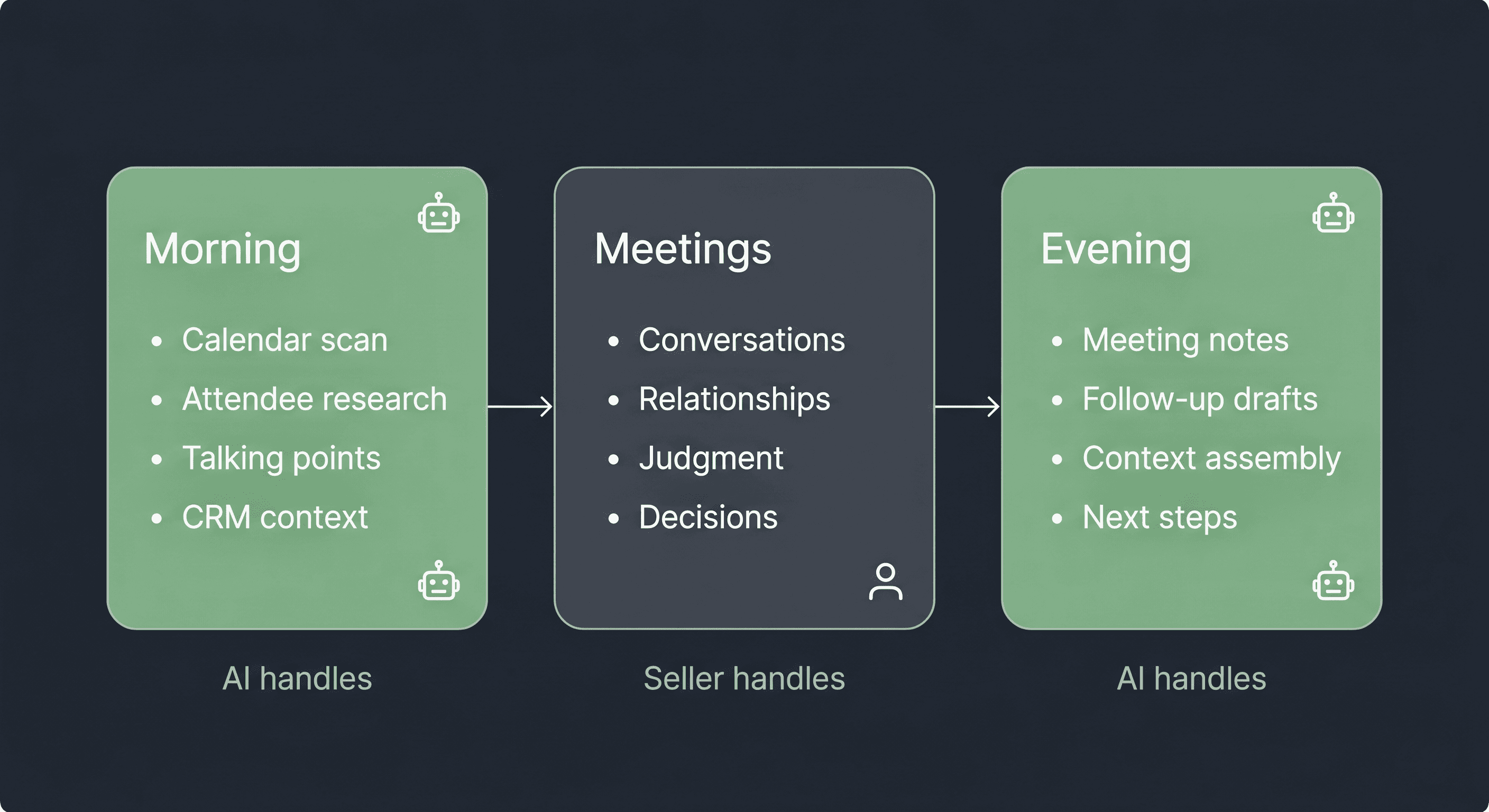
The abstract version of "seller who builds" doesn't mean much until you see what the daily routine looks like. Sires described his workflow as a daily bookend:
Morning: AI reads his calendar, runs web search on attendees, pulls CRM context, and produces talking points for every meeting that day. All via MCP connections to Calendar, CRM, and external data sources. Before he opens his inbox, he knows who he's meeting, what their situation is, and what he should talk about.
Evening: AI pulls meeting notes and Google Docs from the day, drafts follow-up emails, and assembles the context packet for next steps. The admin work that used to eat his evenings happens in minutes.
"You couple those together and you get Claude managing your daily tasks, which essentially becomes an agent."
The seller's job shifts to relationships and judgment. The conversations, the strategic thinking, the reading-the-room moments that close deals. Everything else, the data assembly, the CRM updates, the meeting prep, the follow-up drafts, gets handled by the systems the GTM Architect built.
This scales across the entire team. Sires built 20+ skills across 8 tools. The daily bookend is one workflow. The customer context system is another. Pipeline management is another. Each one removes friction from the whole sales org.
The Systems Become the Moat
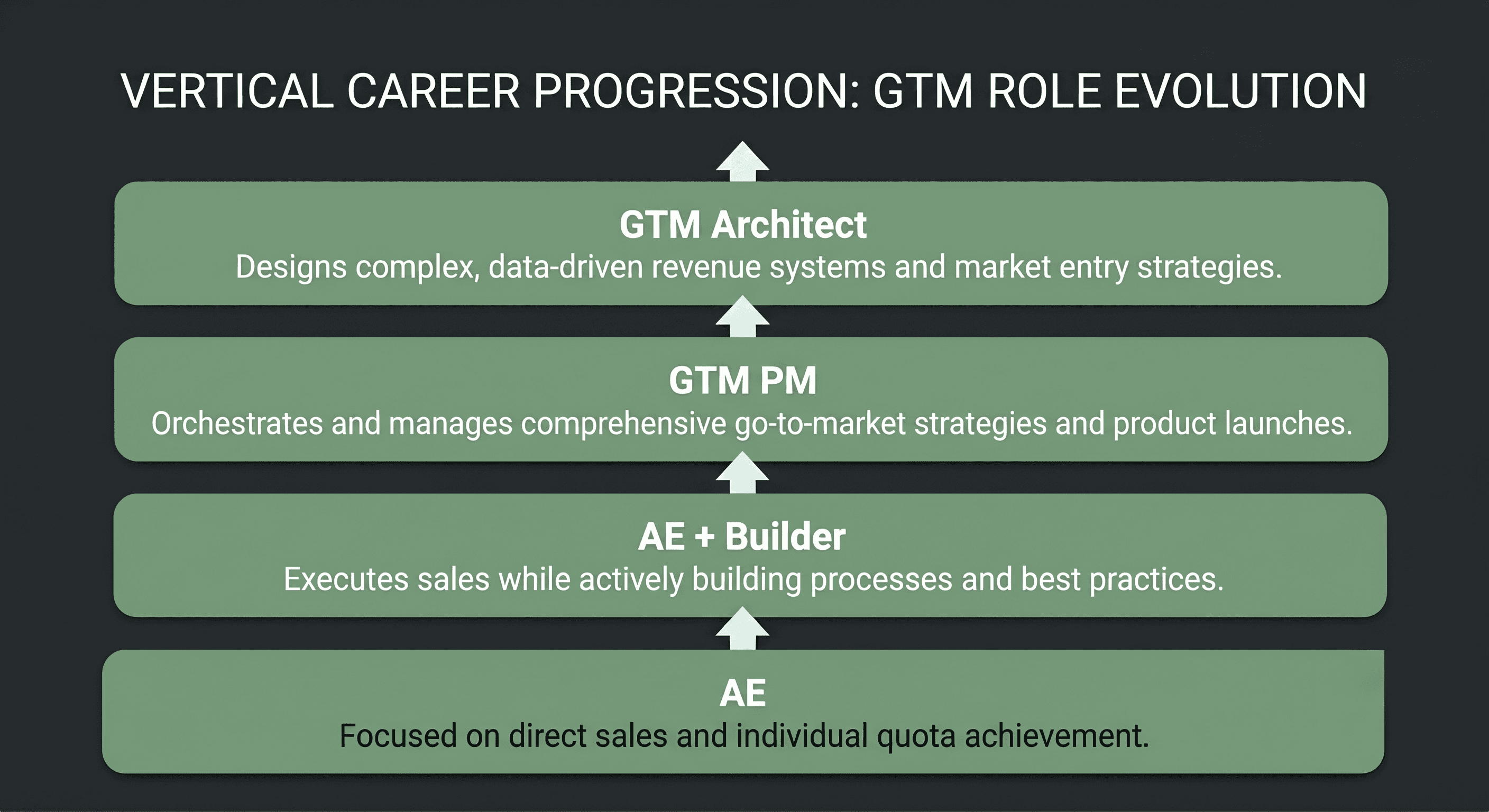
A GTM Architect builds systems that compound.
Every workflow, every automation, every skill becomes part of the company's structural advantage. The enrichment pipeline that took 3 weeks to design and tune is now a permanent asset. The scoring model that surfaces the right accounts is now institutional knowledge encoded in software. The daily brief that pulls from 7 data sources is now infrastructure the whole team depends on.
This is the momentum-into-moat lifecycle. The hire generates momentum immediately: time savings, better data, faster response times, higher conversion rates. The systems they build become the moat. Switching costs so high that migrating 20+ custom workflows to a new platform becomes prohibitive. Institutional knowledge, because the scoring model reflects your actual win patterns. Compounding context that gets smarter every week.
Without this hire, every tool and process lives in someone's head. When that person leaves, the system goes with them. With a GTM Architect, the systems are documented, automated, and transferable. The company stops depending on any one person's tribal knowledge.
Why This Hire Fits the New Reality
There's a structural shift happening in how buyers buy that makes this hire even more relevant.
Buyers are doing their own research before they ever talk to a seller. They're asking Claude about their problem, reading competitor case studies, watching YouTube breakdowns, browsing Reddit threads. By the time they get on your call, they've already done half the discovery work that sellers used to do for them.
This changes what you need from your GTM team. You need fewer people doing manual discovery, because the buyer already Googled it. You need more people building the systems that surface signals showing who's actively buying right now, assemble context so you know everything about an account in 90 seconds, and enable champions with the artifacts they need to sell internally when you're not in the room.
The GTM Architect is the hire that fits this new buyer behavior. They build the signal detection systems. They build the prep layer. They build the champion materials. They make the entire team effective in a world where the buyer shows up more informed than ever.
If you're an operator, reading this and thinking "this sounds like what I already do on a good day," that's the point. Position yourself there. Don't pitch "I can do outbound." Pitch "I can build the system that makes your entire team's outbound 10x more effective." Show the work. Build something that solves your own pain and ship it. That's the resume.
The technical barrier dissolved. The tools are here. The career path has compensation data behind it. The question for your next hiring decision: does this person add one headcount of output, or unlock 20x from the team you already have?