
Case Study
Redesigning the Funnel: How a Bootstrapped Video Ad Tech Platform Nearly Doubled Their Close Rate
This case study details how we rebuilt the client's entire sales funnel and CRM over a 3-month engagement, introducing Clay as the enrichment and scoring engine, restructuring HubSpot into four distinct pipelines, and automating routing and notifications through n8n and Slack.
Intro
When you sell to two completely different buyer types through two completely different motions, running everything through a single pipeline is a recipe for lost deals.
Our client, a bootstrapped video ad tech platform, was generating solid pipeline across publishers and advertisers. Their product was strong: a video player, content marketplace, and SSP serving 5 billion monthly impressions across 1,000+ premium websites. The sales team of five was busy. The problem was that "busy" didn't translate into "closing."
Leads leaked out of the funnel at every stage. Inbound and outbound were treated identically. Publishers and advertisers, two fundamentally different sales conversations, shared a single pipeline. There was no scoring, no routing logic, and no structured follow-up. Reps spent hours each day manually researching and qualifying leads that the system should have handled for them.
This case study details how we rebuilt the client's entire sales funnel and CRM over a 3-month engagement, introducing Clay as the enrichment and scoring engine, restructuring HubSpot into four distinct pipelines, and automating routing and notifications through n8n and Slack. The results: conversion rates improved from 1.7% to 3.2%, advertiser deal cycles dropped from 14 days to 9, and 20 hours of weekly manual qualification work was eliminated across the BDR team.
The Challenge: One Funnel Doing Four Jobs
The client operates in video ad tech. Publishers embed the client's video player on their sites, and advertisers buy programmatic video inventory through their SSP. The publisher sale and the advertiser sale are fundamentally different conversations with different timelines and different close patterns.
The sales team had two BDRs handling top-of-funnel qualification and three AEs closing deals. They were bootstrapped, working toward seed funding, so every rep's time was critical and every lost deal was expensive.
A Single Pipeline for Everything
The CRM had one pipeline. Every lead, whether it was a publisher interested in embedding the video player or an advertiser looking to buy video inventory, landed in the same funnel. Inbound form submissions sat next to outbound prospecting targets with no differentiation in how they were worked.
This created confusion at every level. BDRs had no clear criteria for how to qualify a publisher versus an advertiser. AEs received leads with no context on where they came from or why they were being handed off. Leadership couldn't accurately forecast because publisher deals and advertiser deals had completely different timelines and close patterns, but the pipeline treated them as one.
No Scoring, Slow Follow-Up
There was no lead scoring system. Every inbound lead received the same priority regardless of company size, role, or fit. BDRs spent roughly two hours per day manually researching leads, looking up companies, checking fit, and trying to determine which ones deserved immediate attention.
The manual research created a bottleneck. Inbound leads that came in hot would sit for up to 24 hours before a rep made contact. By then, the urgency had faded. Leads that should have been fast-tracked to an AE, large publishers or advertisers with clear buying signals, sat in the same queue as everything else.
Leads Leaking Everywhere
The lack of structure meant leads dropped out of the funnel at every stage. Top-of-funnel leads went uncontacted for too long. Mid-funnel deals stalled because there were no stage requirements or follow-up triggers. There was no alerting for stale deals, so opportunities would quietly die in the pipeline without anyone noticing until it was too late.
The team was generating enough pipeline to hit their numbers. They just couldn't consistently convert it.
The Solution: Four Pipelines, One Scoring Engine
Partnering with Fortuna, the client rebuilt their sales infrastructure over a 3-month retainer engagement. The redesign touched every layer: lead intake, enrichment, scoring, pipeline structure, routing, and team notifications.
Phase 1: Clay as the Intake and Scoring Engine
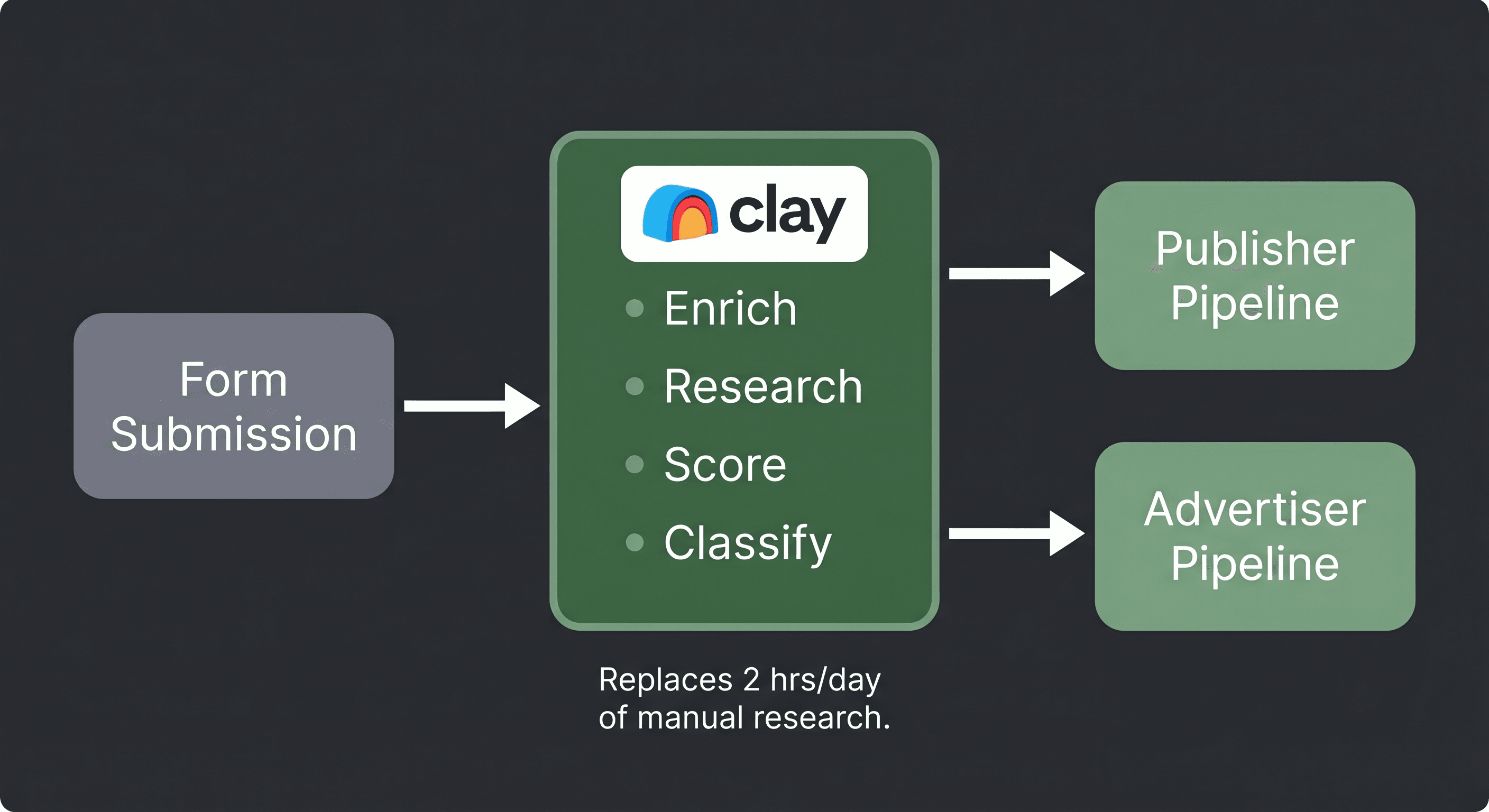
The biggest architectural decision was introducing Clay as the first stop for every inbound lead, before HubSpot.
When a lead submitted a form on the website, it flowed directly into Clay. From there, Clay handled the full intake sequence:
Enrichment. Clay pulled company data, contact details, firmographic information, and role context for each lead
Research. Clay ran automated research on the company or individual publisher/advertiser to understand their scale, current tech stack, and relevance to the client's offerings
Scoring. Based on the enrichment and research data, Clay assigned a lead score that factored in company size, role seniority, industry fit, and buying signals
Classification. Clay determined whether the lead was a publisher or advertiser and routed it accordingly
This replaced the two hours per day each BDR had been spending on manual research and qualification. The system did in seconds what previously took 15-20 minutes per lead.
Phase 2: Four Distinct Pipelines in HubSpot
With Clay handling classification, we restructured HubSpot from one generic pipeline into four purpose-built pipelines:
Inbound Pipelines:
Publisher Inbound (4 stages). Tailored to the publisher sales motion, which moved faster and had a shorter qualification cycle
Advertiser Inbound (5 stages). Designed for the longer advertiser conversation, which required more discovery, proposal customization, and negotiation
Outbound Pipelines:
Publisher Outbound (5 stages). Separate cadence and qualification flow for publishers sourced through outbound prospecting
Advertiser Outbound (5 stages). Separate outbound motion for advertisers with its own progression logic
Each pipeline had gating criteria at every stage. Reps had to complete specific actions and fill specific fields before moving a deal forward. This eliminated the old pattern of deals being dragged through stages without proper qualification and gave leadership reliable pipeline data for forecasting.
Phase 3: Automated Routing and Hot Lead Escalation
The routing logic, built in n8n, connected Clay's scoring output to HubSpot's pipeline assignment. Leads were automatically placed in the correct pipeline based on Clay's classification, and assigned to the appropriate rep.
The system also introduced hot lead escalation. When Clay's scoring identified a highly qualified lead with strong buying signals, that lead skipped the BDR qualification stage entirely and went straight to an AE. This ensured the strongest opportunities got senior attention immediately rather than waiting in a BDR queue.
For standard qualified leads, the automated flow assigned them to the appropriate BDR with full enrichment data and a score, so the rep could pick up the conversation with context instead of starting from scratch.
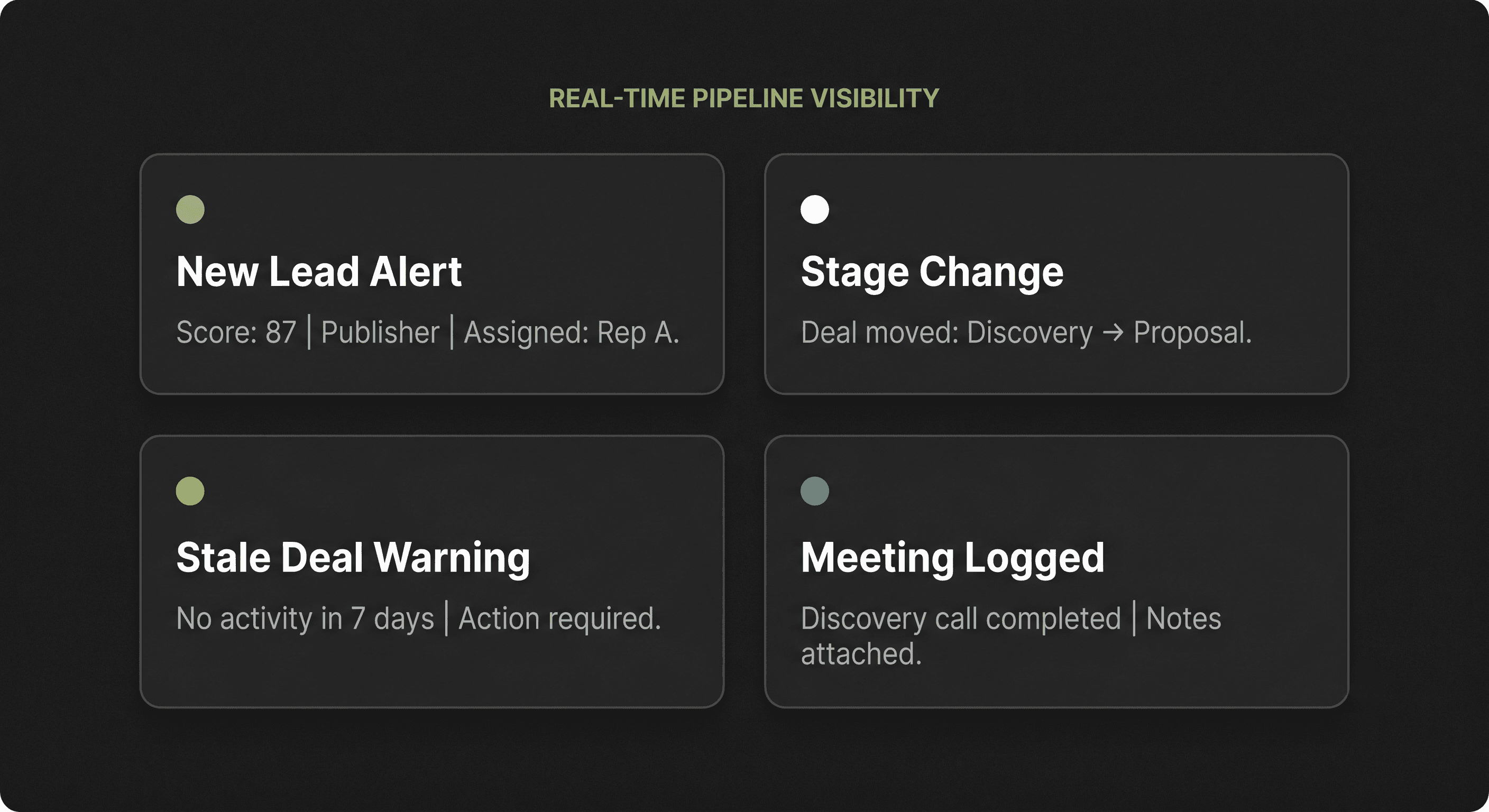
Phase 4: Slack as the Nerve Center
Slack became the real-time layer on top of the pipeline. We set up structured notifications across dedicated channels:
New lead alerts. When a scored and routed lead landed in a pipeline, the assigned rep received an instant notification with the lead's details, score, and enrichment summary
Stage change updates. When deals moved through pipeline stages, the broader team received updates so leadership and adjacent reps had visibility
Stale deal alerts. If a deal sat in a stage past a defined threshold without activity, the system flagged it in Slack so it wouldn't quietly die
Meeting and call updates. Activity on deals was surfaced to the team so everyone had context on active conversations
This replaced the pattern of reps silently working deals in their own HubSpot view with no team-wide visibility.
The Results: Faster Cycles, Higher Conversion, Less Manual Work
The redesign produced measurable improvements across conversion, velocity, and rep efficiency.
Conversion Rate: 1.7% to 3.2%
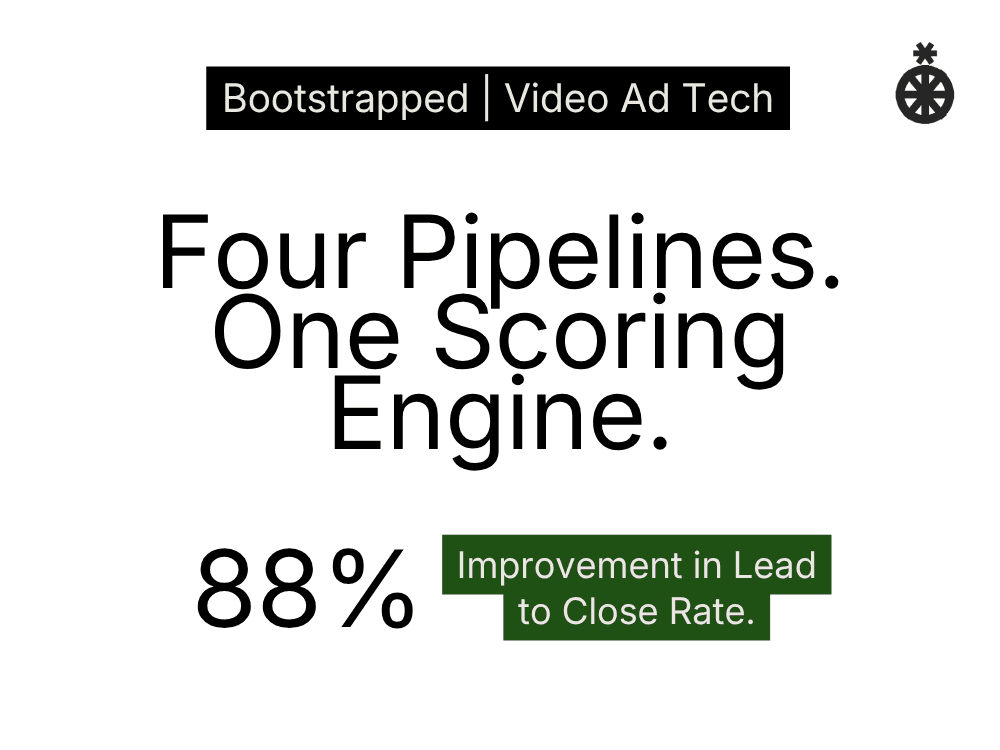
Better scoring meant reps focused on leads with actual buying signals. Better pipeline structure meant deals were properly qualified at each stage instead of being pushed through prematurely. The combination drove a 88% improvement in overall close rate.
Advertiser Deal Cycle: 14 Days to 9 Days
The advertiser pipeline saw the sharpest velocity improvement. Pre-qualification through Clay meant AEs entered conversations with enriched context and confirmed fit. The gated pipeline stages kept deals from stalling in limbo. The result was a 36% reduction in time to close for advertiser deals.
20 Hours of Weekly Manual Work Eliminated
The two BDRs had been spending roughly two hours each per day on manual lead research and qualification. That's 20 hours per week across the team. Clay's automated enrichment, scoring, and classification replaced that work entirely, freeing the BDRs to focus on outbound prospecting and lead engagement.
Faster Inbound Response Times
Automated qualification and routing cut the average inbound follow-up time from 24 hours to under 15 minutes for qualified leads. The hot lead escalation path meant the best inbound opportunities reached an AE within minutes of form submission.
Pipeline Visibility for Leadership
With four separate pipelines, gated stages, and Slack notifications on deal movement, leadership gained accurate, real-time visibility into the sales operation. Publisher and advertiser pipelines could be forecasted independently. Stale deals surfaced automatically instead of hiding in a rep's personal view.
Conclusion: Different Buyers Need Different Funnels
The core lesson from this engagement is straightforward: if you sell to different buyer types through different motions, you need different pipelines. Forcing publishers and advertisers through the same funnel, and treating inbound and outbound identically, created friction at every stage and made it impossible to optimize any single motion.
The fix was structural, not incremental. Adding a lead scoring tool on top of a broken pipeline wouldn't have solved the problem. The pipeline itself needed to be redesigned around the reality of how the client actually sells.
Clay as the intake layer did the heavy lifting on enrichment and classification. HubSpot's four pipelines gave each selling motion its own structure and gating. n8n connected the pieces. Slack made the whole system visible. No single tool was the answer. The system was.
At Fortuna, we engineer sales infrastructure that matches how your team actually sells, not how your CRM was configured out of the box.
"We knew we were losing deals, we just couldn't see where. Once the pipelines were separated and the scoring was automated, the gaps became obvious and the fixes were immediate. Our advertiser close time dropped by a third in the first month."
Head of Sales