Case Study
Streamlining Partner Operations at a Series B Startup: Cutting Onboarding by 17 Days and Automating 95% of Monthly Reviews
Our client, a Series B Startup, helps logistics businesses maximize revenue through dynamic pricing, real-time analytics, and occupancy tracking. Their technology drives unparalleled revenue growth for 300+ assets across North America.
Intro
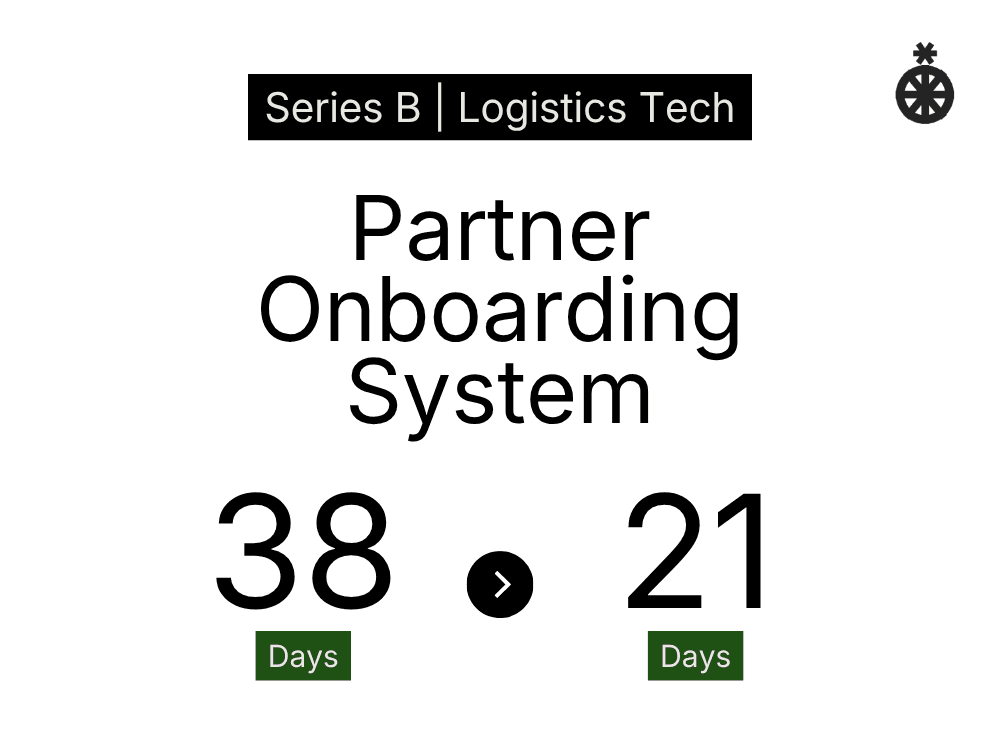
Growth at that scale creates operational complexity. When your team manages hundreds of partner relationships, manual processes become a bottleneck. The startup's partnerships team was drowning in Excel files, fragmented data across four disconnected tools, and a partner onboarding process that took 38 days.
This white paper details how we engineered a unified partner management headquarters in Notion over 6 weeks:
Reducing onboarding time by 17 days,
Eliminating $15,000 in annual tool costs, and
Cutting monthly review cycles from 3 hours to 10 minutes using custom AI agents.
The Challenge: When Partner Growth Creates Process Gridlock
Managing 300+ partnerships requires precision. Each partner has unique pricing models, performance metrics, and operational requirements. When the startup's partnerships team hit that scale, their infrastructure couldn't keep up.
Fragmented Data, Invisible Bottlenecks
The team operated across four disconnected tools. Separate systems for partner tracking, project management, task tracking, and meeting notes.
None of them talked to each other.
The cost was measurable:
No visibility into partner health: Leadership couldn't see which partnerships were thriving or at risk
Manual Excel processing: Monthly partner reviews required hours of copy-paste work from multiple team sources
Scattered information: Partner data lived in four places, making context-switching constant
Inconsistent workflows: Each partner manager had their own process
The Monthly Review Tax
Every month, the partnerships team compiled performance data across 300+ partners. The process involved collecting Excel files from multiple teams, manually reviewing notes and updates, identifying priority issues, and surfacing action items to leadership.
Total time: 3 hours of manual data wrangling.
The work wasn't strategic. It was administrative overhead disguised as partner management.
The Onboarding Bottleneck
New partners took 38 days to fully onboard. The process involved manual task assignments, scattered documentation, unclear handoffs between teams, and no automated status tracking.
Each delayed day was lost revenue, for both the startup and their partners.
The Solution: Building Partner Operations Infrastructure
Partnering with Fortuna Systems, the client rebuilt their partner management infrastructure from the ground up. We architected a unified operating system in Notion powered by custom AI agents and automation.
Week 1: Systems Audit
We started by mapping reality on the ground.
We interviewed the partnerships team, documented every manual touchpoint, and traced data flows across all four tools.
The audit revealed clear opportunities:
Fragmented partner data that could be centralized,
Repetitive tasks that could be automated, and
Tribal knowledge that could be systematized.
The team wasn't choosing inefficiency. The system was forcing it on them.
Weeks 2-4: Building the Partner Management Headquarters
We built Notion as the central nervous system for partner operations, connecting all the pieces that previously lived in silos.
Unified Partner Database
We consolidated 300+ partner records into a single Notion database with complete relationship history, performance metrics, contact information, and project tracking.
No more hunting across four tools to understand a partner's status.
Custom AI Agents (Notion Beta)
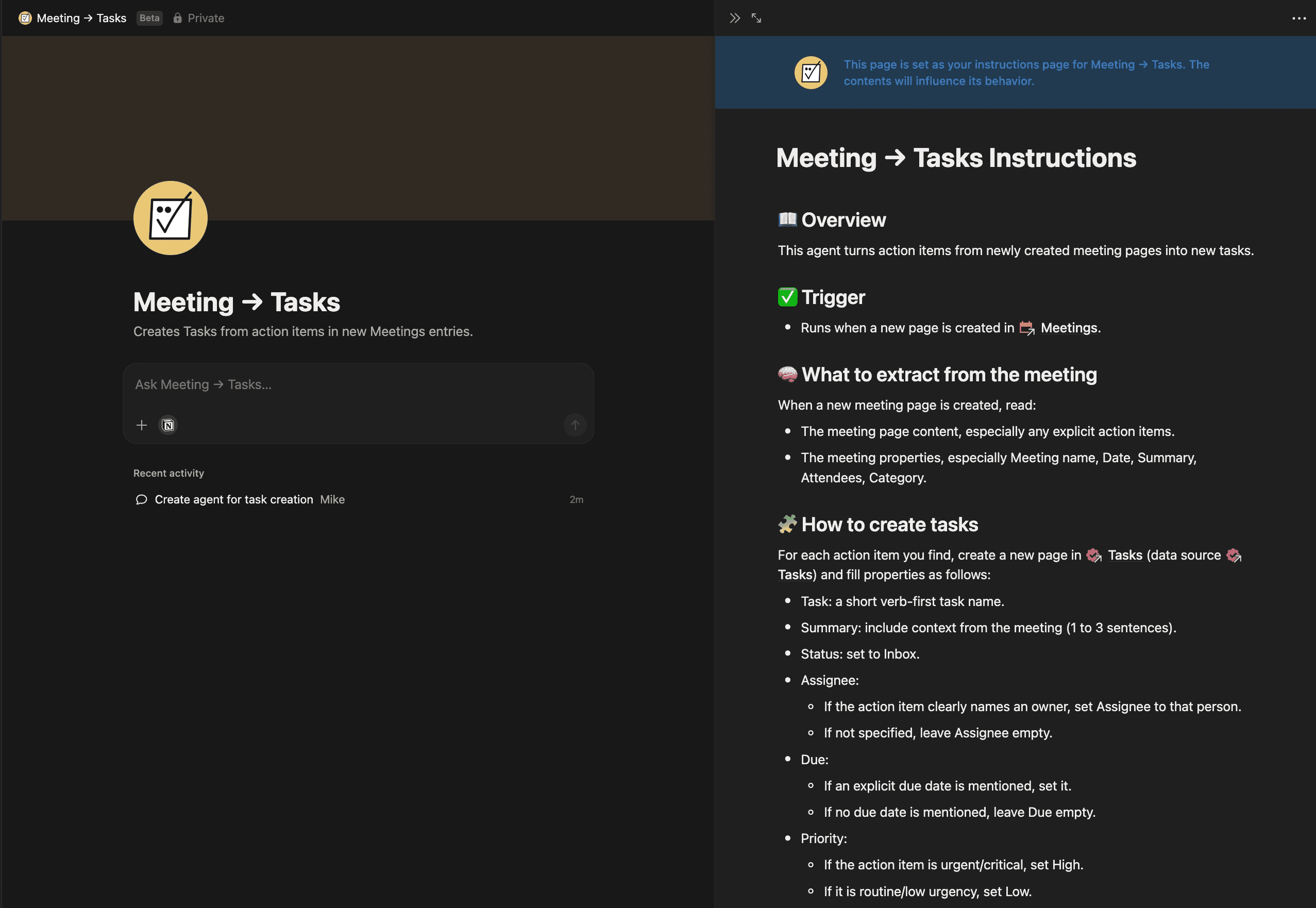
We deployed 5+ custom AI agents using Notion's new beta functionality. These agents operate on triggers—when a partner record is updated, when a monthly review is submitted, when tasks are assigned, when new meetings are captured, and when new partners start their onboarding process. Each agent processes markdown instructions and executes specific workflows automatically.
When teams submit their partner notes and Excel updates, the AI agent automatically extracts priority action items, categorizes issues by urgency, and surfaces key decisions to leadership. What took 3 hours now takes 10 minutes.
The monthly review agent became the game-changer.
Automated Task Assignment & Notifications
When work is assigned to a partner manager in Notion, automated Slack notifications fire immediately. No more missed tasks. No more "I didn't see that notification."
We integrated Slack, email, and Google Workspace so the system communicated across channels the team actually uses.
Onboarding Automation
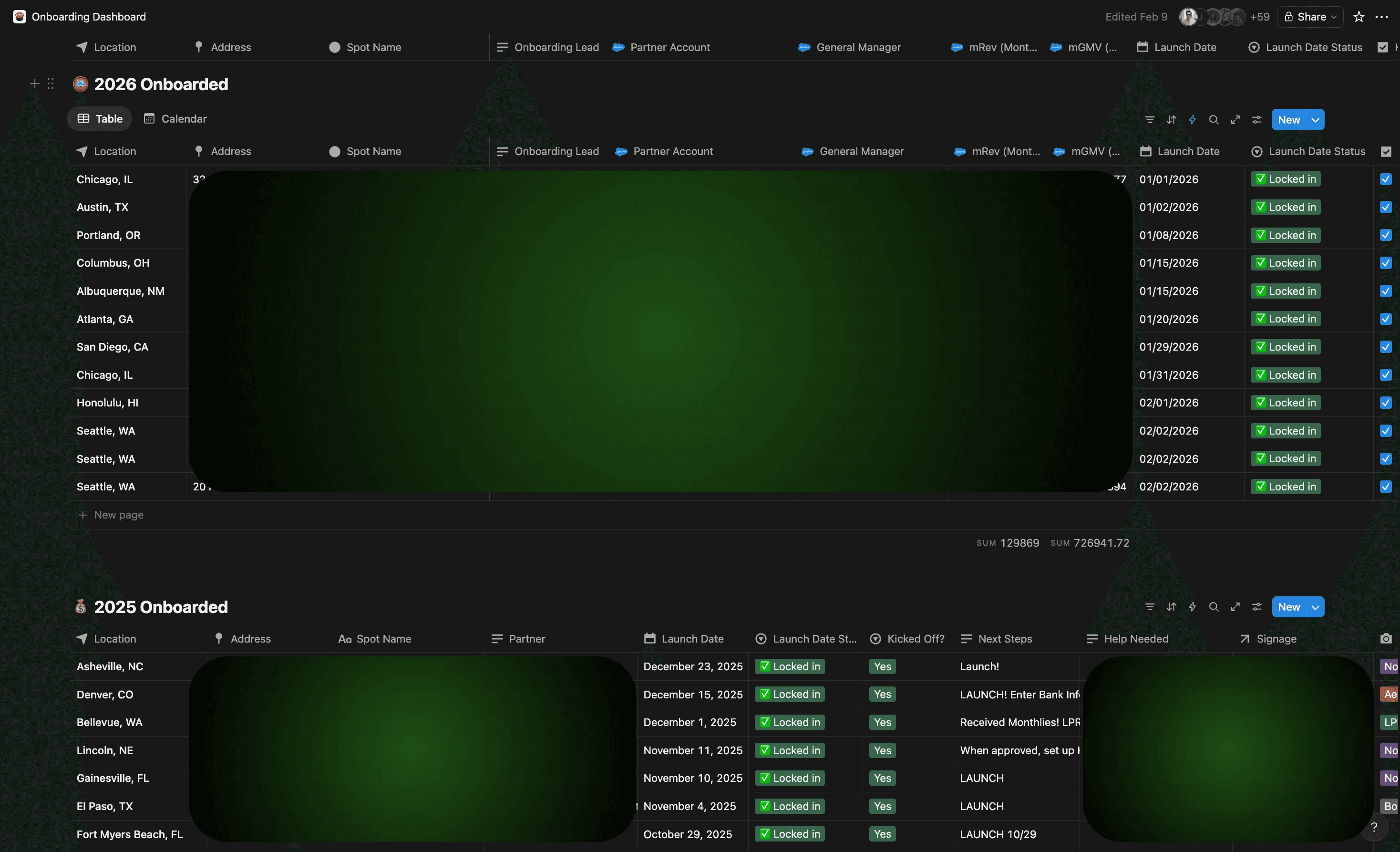
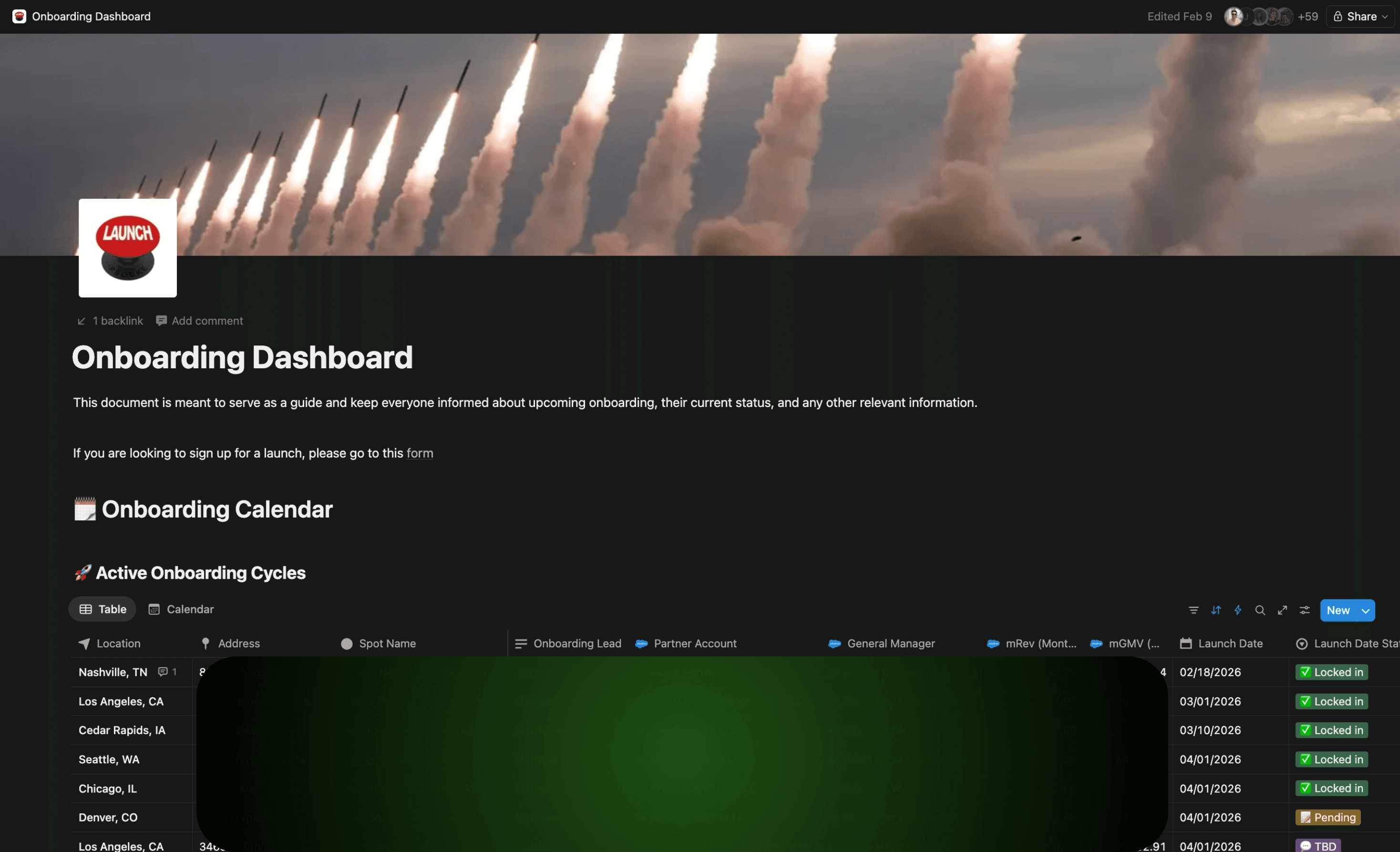
We built a structured onboarding dashboard that tracks every step of the partner activation process.
Automated workflows trigger task sequences, send reminders, and update status in real-time. The system eliminated manual coordination overhead.
Weeks 5-6: Training and Knowledge Transfer
Automation only works if the team adopts it.
We spent two weeks training the partnerships team on the new workflows, documenting processes as living SOPs inside Notion, and refining the AI agent instructions based on real-world usage.
The final deliverable was a self-sustaining system. The team could operate it, modify it, and scale it without ongoing external support.
The Results: From Manual Overhead to Strategic Focus
The transformation delivered measurable impact across three critical dimensions.
17 Days Faster Partner Onboarding
By automating task sequences, centralizing documentation, and eliminating handoff delays, we cut onboarding time from 38 days to 21 days—a 45% reduction.
That speed compounds. Faster onboarding means partners see revenue faster. It means the business can scale partnerships faster. It means the team can focus on relationship-building instead of project management busywork.
$15,000 in Annual Tool Consolidation Savings
We eliminated three tools by consolidating everything into Notion. Partner tracking, project management, task tracking, and meeting notes now live in one place.
The savings were immediate: $15,000 per year in eliminated license costs across the partnerships team. The efficiency gains were harder to quantify but equally real—context-switching overhead disappeared when all data lived in one system.
94% Faster Monthly Reviews
The custom AI agent transformed the monthly review process. What previously took 3 hours of manual Excel processing now takes 10 minutes.
The agent reads partner notes, identifies priority action items, categorizes issues by severity, and surfaces key decisions to leadership automatically. The team went from data entry clerks to strategic reviewers.
Human judgment still matters. The AI surfaces insights—leadership makes the calls. The system doesn't replace thinking. It eliminates the busy work that prevents thinking.
Conclusion: Operational Leverage Through Systems
The lesson from this Series B startup is clear: Manual processes don't scale.
You can't "try harder" your way out of fragmented tools and spreadsheet workflows. Asking your team to "stay on top of tasks" or "keep better notes" is a losing strategy.
Human discipline will always lose to system friction.
The solution is better infrastructure.
Tools alone don't solve the problem. Buying Notion or Slack or Salesforce doesn't magically create efficiency. In fact, adding tools without integration often creates more chaos.
What works is systems engineering.
Architecting data flows,
Automating handoffs,
Deploying AI where repetition exists, and
Making the right action the default action.
At Fortuna, we engineer your operations for scale.
Ready to Automate Your Workflows?
Is your team struggling with similar challenges? Are you looking to streamline your processes, reduce costs, and boost productivity?
When you’re ready, I can help you:
I’m Mike - a systems builder and startup expert.
I help early stage startups manage and optimize their operations with simple, scalable systems - built using tools like Notion, Slack, and n8n.