
Article
The 4-Step Automation Gameplan That Actually Works
Most businesses try to layer complex tools on top of broken processes. They buy the automation platform, watch three YouTube tutorials, and start connecting things. Two weeks later, the workflows are broken and nobody trusts the system.
The problem isn't the tools. The problem is skipping the step that makes automation actually stick.
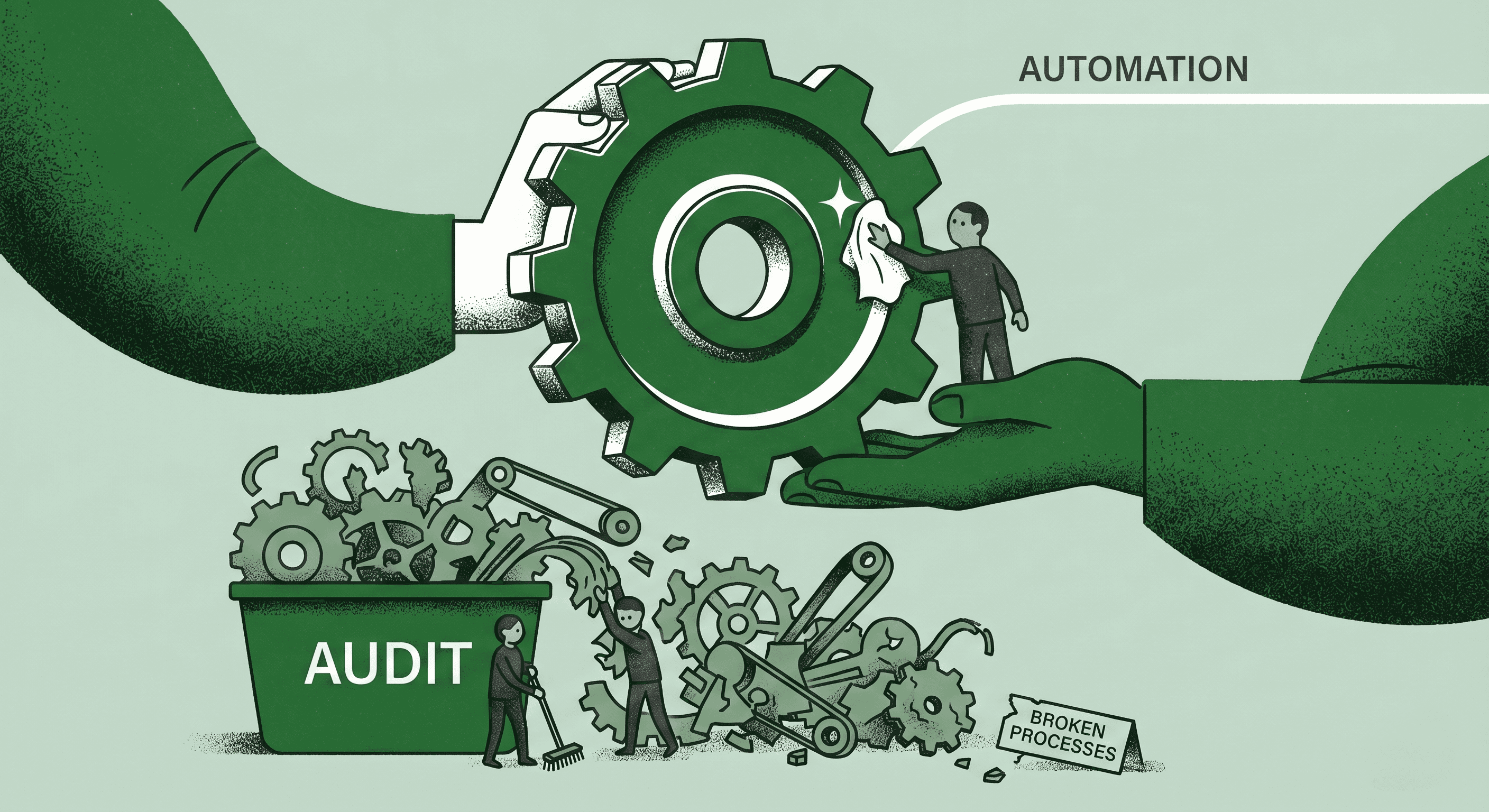
Most businesses try to layer complex tools on top of broken processes. They buy the automation platform, watch three YouTube tutorials, and start connecting things. Two weeks later, the workflows are broken and nobody trusts the system.
The problem isn't the tools. The problem is skipping the step that makes automation actually stick.
You can't automate what you don't understand.
Audits are the simplest and most efficient way to find high-impact automation opportunities in your business. Here's the 4-step system we use with every client before a single workflow gets built.
Step 1 — Internal Survey and Audit
Don't overcomplicate this. Use a simple form. Typeform, Tally, Notion Forms — whatever your team already uses.
Ask three questions. What tasks do you do every day or every week? What are the most annoying tasks you perform each month? What's stopping you from hitting your goals for your role?
These questions surface the friction that matters most. High emotional friction usually equals high automation ROI. The tasks people complain about most are almost always the best candidates for automation.
The survey gives you a starting map. It tells you where the pain lives across your team without you having to guess.
Step 2 — Record the Workflows
Surveys give you data. Interviews give you context.
Schedule 30 minutes with your key operators and watch them work. Record the session. Watch it back and ask "why" at every step.
This is where you catch the edge cases that will break your automations later. The workarounds people have developed. The manual steps that exist for reasons nobody remembers. The exceptions that happen once a month but completely derail the process when they do.
You're building understanding here, not solutions. The solutions come later.
Step 3 — The Napkin Blueprint
If you can't map it, you can't build it.
Take everything you've learned and map the entire signal stack visually. Inputs, orchestration, outputs. What triggers the process, what happens during it, and what comes out the other end.
Don't write a single prompt or connect a single node until the logic is clear on paper. A napkin sketch is fine. A whiteboard is better. The format doesn't matter. Clarity does.
Then run the process manually, strictly following your process map. This is your stress test. If it breaks when a human follows it step by step, it will definitely break when software tries to run it.
Step 4 — The Elimination Protocol
This is the step most teams skip, and it's the most important one.
The goal isn't to automate everything you touch. The goal is to do more with less. Once you've mapped things out, filter every task through a simple funnel.
First, ask if you should eliminate it. If a task isn't adding value somewhere in the business, stop doing it entirely. No automation needed.
Next, ask if you should simplify it. If the task is necessary but complex, standardize it first. Strip out the unnecessary steps and variations before you try to automate the mess.
Finally, ask if you should automate it. If the task is logical, repeatable, and impactful for the business, now you build the workflow.
Most "automation" problems are actually process problems. When you take time to map things out, you discover what's actually moving the needle for your business and what's just noise.
The Takeaway
Don't rush to implement. Audit first. Automate second.
The teams that get the most value from automation aren't the ones with the fanciest tools. They're the ones who understood their processes deeply before they started building. That understanding is what separates automations that last from automations that break in three weeks.