
Article
The Flattening: Why Tech Stacks and Org Charts Are Collapsing to the Same Architecture
Tech stacks and org charts are flattening at the same time. The architecture that survives has three layers: systems of record, AI orchestration, and an action layer.
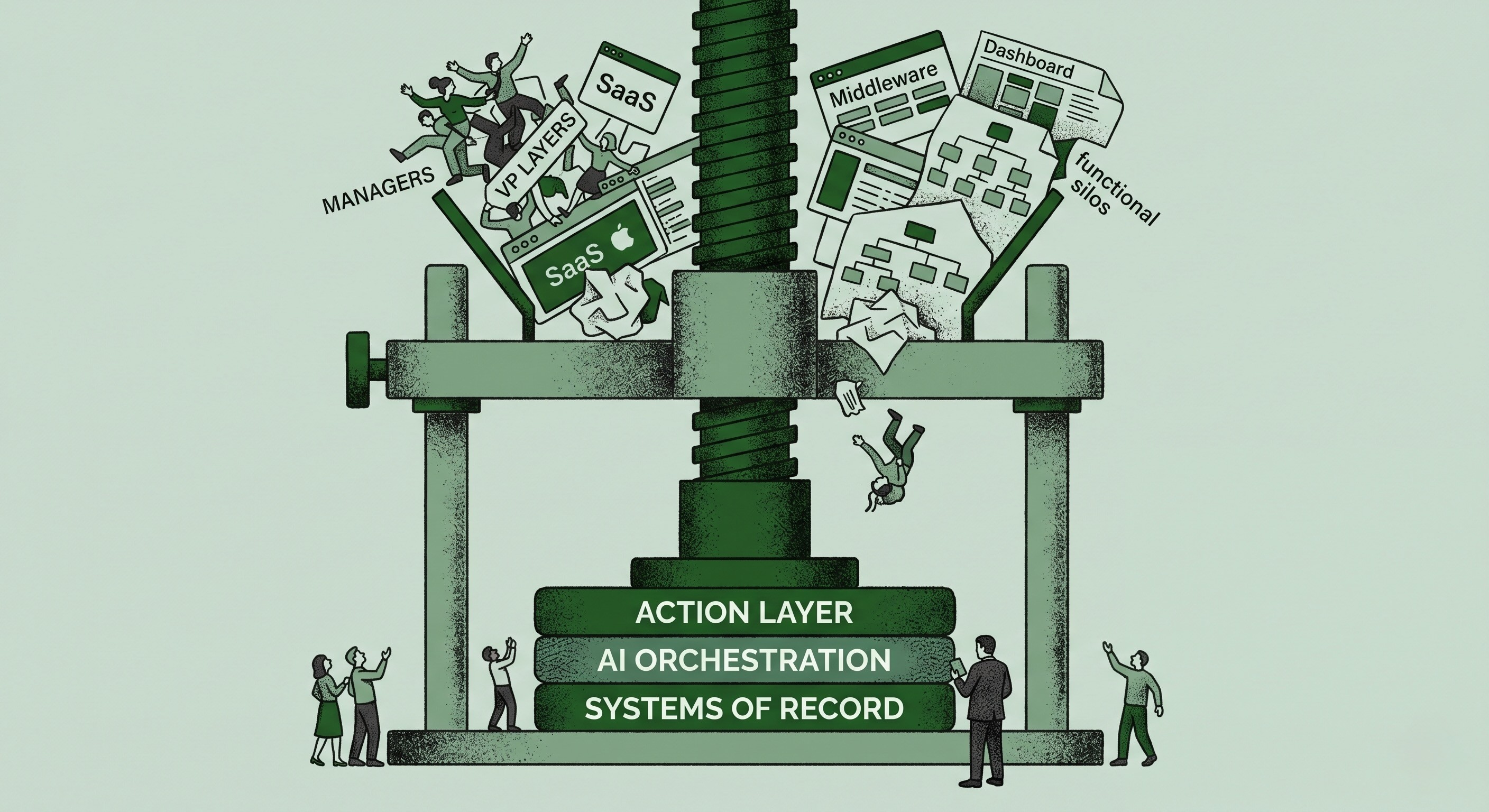
Two things are happening at the same time right now. Tool stacks are compressing. Org charts are compressing. The operators staying ahead are all building on the same three-layer architecture.
Over the past year, I've watched both the tech stack architecture and organizational structures compress simultaneously. The companies getting this right all landed on the same three-layer model: systems of record at the base, AI orchestration in the middle, and an action layer on top where work actually gets done. The companies getting it wrong are still adding tools and adding managers, hoping more layers solve the problem that layers created.
This is the same structural force hitting both sides of equation at once.
Everything Is Flattening at Once
On the technology side, the compression is accelerating. Tim Carden documented how he replaced 12 SaaS seats with 33 APIs and a terminal, using Claude Code as the meta-orchestrator. David Arnoux put it bluntly: "Your UI is no longer the product. Your API is. Your data model is. Your connector layer is." The entire tech landscape is being restructured around APIs and AI orchestration instead of standalone SaaS dashboards.
The same thing is happening on the organization side. Middle management layers are getting culled in favor of flatter structures and player-coaches who contribute directly to either building the product or generating revenue. At my company, we run three reporting levels across every team, including:
IC,
Manager, and
Division Lead.
That's it. No directors of directors. No VP layers coordinating other coordinators.
These are the same force, not two distinct threads. AI raises individual output, which means you need fewer coordination layers in both your tools and your people. When one person can do the work that used to require three, you don't need the manager who existed to coordinate those three. When Claude Code can connect your CRM to your enrichment pipeline to your outreach tool, you don't need the middleware SaaS that existed to bridge them.
Tim Rutten, CMO at Backbase (a €2.5B FinTech), proved this at enterprise scale. He collapsed functional marketing silos into what he calls "generalists, amplified." One ABM manager now runs what used to require a content team, a digital team, a PMM, and a demand gen function. Pipeline grew 85%+ year-over-year with a 60%+ increase in average deal size.
The Middleware Graveyard
The tools that are dying right now only existed because integration was hard.
AI orchestrators like Claude Code and n8n collapsed the integration layer. If your product was the glue between two other systems, you're the glue that's no longer needed. Seth London, who leads GTM AI at Meltwater, put a hard filter on it. His team won't consider any new solution that introduces another UI unless it consolidates two or more existing tools. Each investment should net-reduce the number of tools reps touch.
Here's a simple survival test for every SaaS tool in your stack: does it own real data, or does it deliver clear user value that an AI orchestrator can't replicate? If the answer to both is no, it's middleware. It exists to move data between point A and point B, and that job is being automated away.
David Turewicz demonstrated this when he collapsed six systems into three pillars plus RevOps, generating $14M in client revenue. Claude replaced Clay as his primary processing engine. Claude handles enrichment, playbook creation, lead sourcing, copy generation, campaign builds, and auto-optimization. Clay still runs inside his outbound stack for ABM signals, but Claude sits above it as the intelligence layer. The middleware between his systems disappeared because Claude became the connector.
The tools that survive this shift will be the ones that become infrastructure for the orchestration layer. They'll own critical data (your CRM, your data warehouse) or deliver user value that genuinely requires a dedicated interface (your design tool, your communication platform). Everything in between is a candidate for unbundling.
The Architecture That Scales
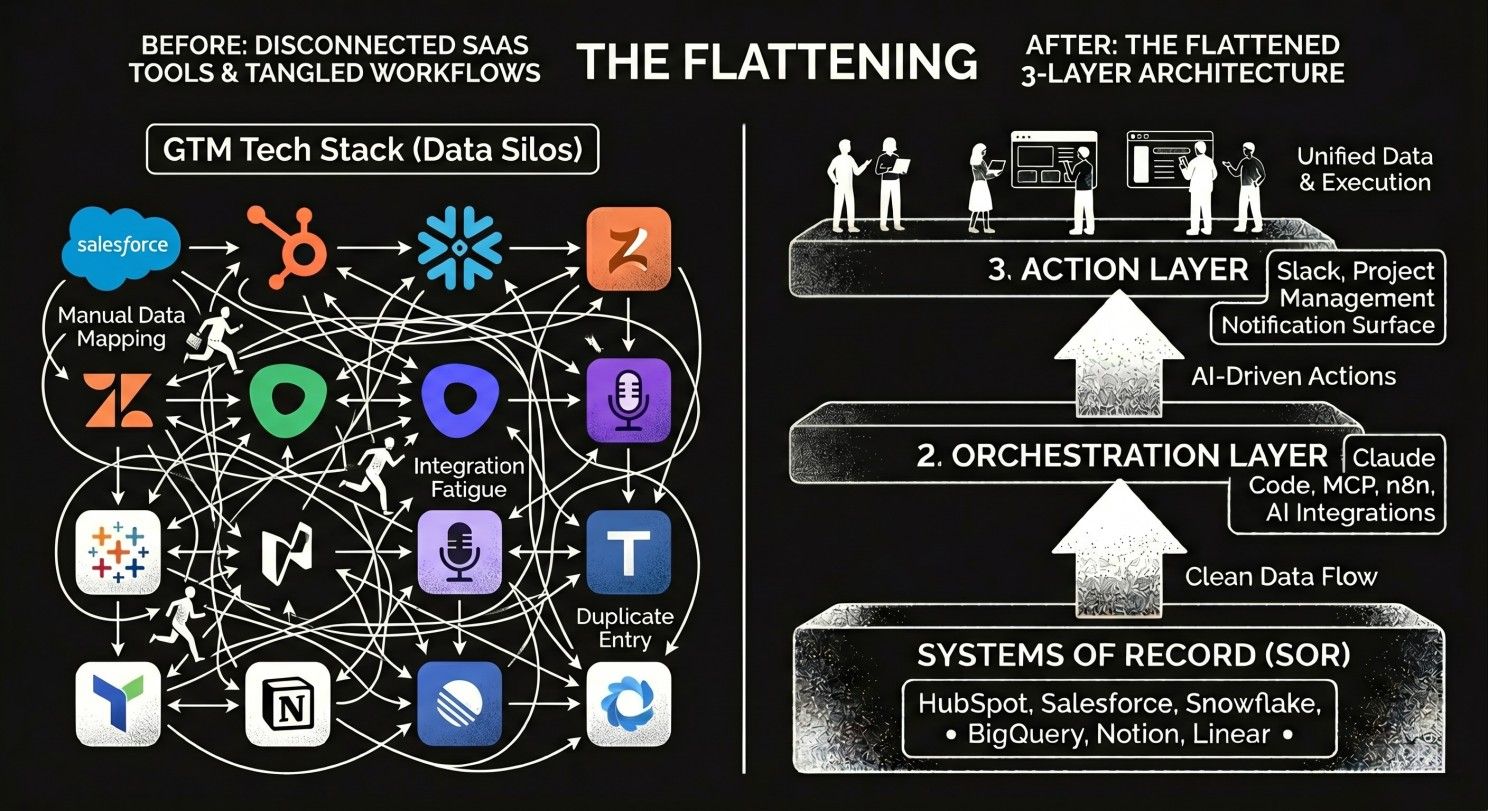
The architecture that works has three layers.
Three-layer GTM stack architecture: systems of record, AI orchestration, and action layer.
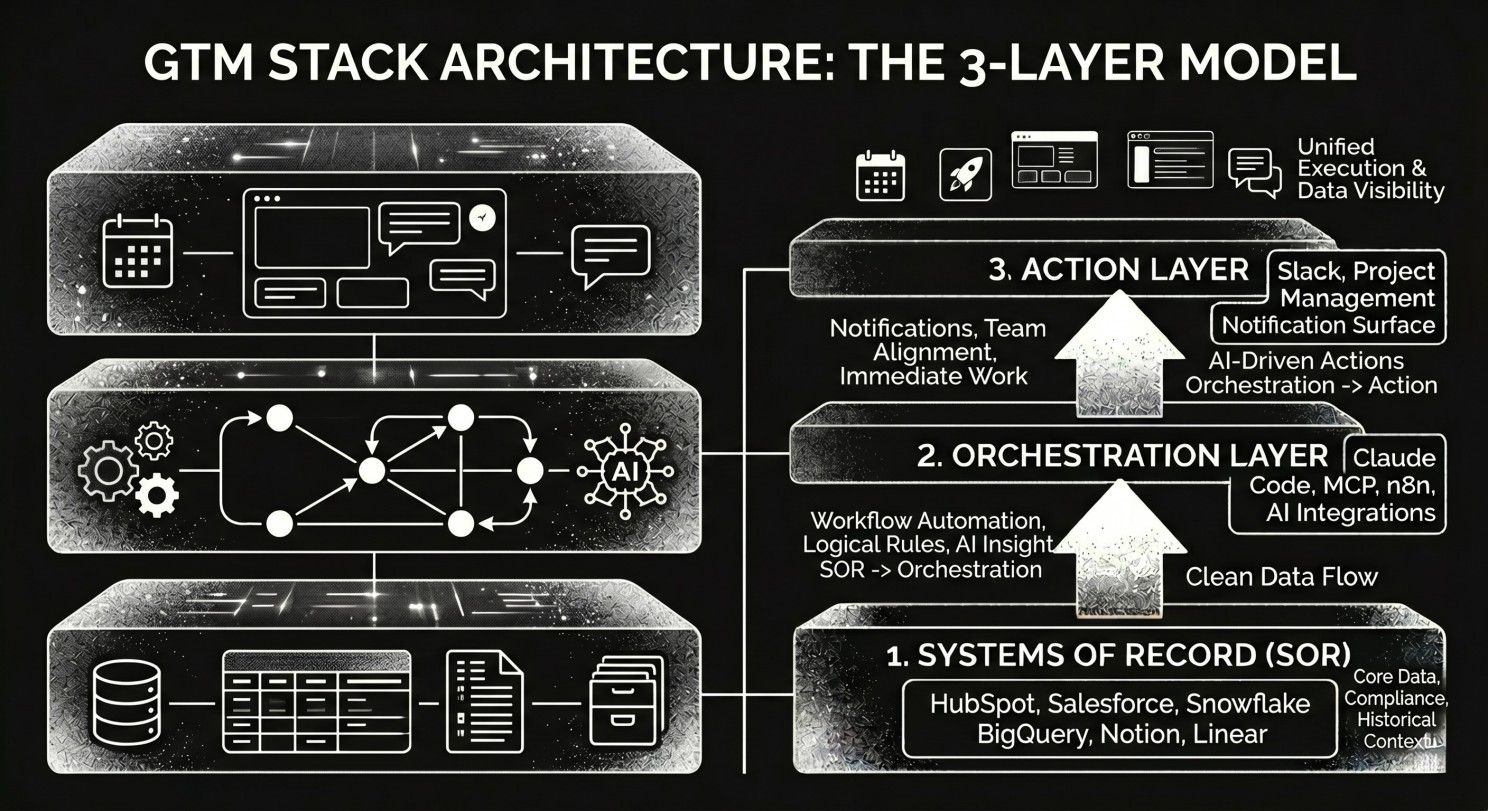
Layer 1: Systems of Record.
This is where your core shared data lives.
Your CRM (HubSpot, Attio, Salesforce), your data warehouse (Snowflake, BigQuery), your project management system (Notion, Linear).
These tools must be proven, scalable, and accessible via API.
The key criterion: if this tool went down, would your team lose access to critical shared data? If yes, it's a system of record. If no, it might be middleware pretending to be infrastructure.
Project tracking lives here too. Your team's tasks, priorities, and accountability chains need to be in the SOR layer so the orchestration layer can keep actions flowing and everyone stays aligned.
Layer 2: Orchestration.
This is where AI connects everything.
Claude Code, n8n, MCP integrations. The orchestration layer reads from your systems of record, applies logic and intelligence, and pushes actions to where your team works.
This is where you build proprietary combinations that create competitive advantage. Everyone has access to the same building blocks, and the edge comes from how you assemble them.
Layer 3: Action.
This is where work actually happens.
Most of the time, it's Slack. Wherever your team already spends their day and treats notifications as immediate things they need to do.
The orchestration layer pushes enriched, contextualized actions directly into the tools people already have open. A qualified lead doesn't sit in a dashboard waiting to be discovered. It shows up in a Slack channel with the context attached and the next step clear.
The shift is from renting someone else's UI to routing AI-orchestrated actions into the surfaces your team already uses.
Where the Vibe-Coded Approach Breaks
This architecture sounds clean in theory. In practice, there's a trap that catches a lot of early-stage teams.
GTM stack flattening from 12 SaaS tools to three-layer architecture.
Bespoke AI-built systems work beautifully when you're small. Markdown files, git repos, Claude Code skills, custom scripts. The setup is fast, flexible, and cheap at that stage. Fivos Aresti runs a 20-person agency on 79 Claude skills and 26 custom agents, treating the entire company setup like a software project in GitHub.
But in my experience, once you get past roughly 40-50 people, the edge cases, maintenance overhead, and infrastructure debt start overwhelming the team. The cost of maintaining a custom Snowflake setup with bespoke applications exceeds what a scalable SOR like HubSpot or Attio would have cost out of the box. You end up hiring DevOps engineers to maintain internal tools instead of revenue-generating team members.
Anthropic's Founder's Playbook names this risk explicitly: agentic technical debt. AI removes the natural bottlenecks that used to force deliberate decision-making. When building feels effortless, speed becomes the default, and teams accrue structural debt they don't recognize as debt. The code works. The system runs. But the pieces were never designed to fit together at scale, and you only discover that when it's expensive to fix.
That's why I think the most efficient way forward is bespoke for the individual, scalable for the org.
I run my personal book of business on Claude, Notion, GitHub, Slack and HubSpot. My personal AI workflows are custom-built and optimized for how I work. But the key data that's relevant to my whole team (and where I pull all the key info from) lives in Notion and HubSpot as organizational systems of record. I don't expect anyone else to run my personal setup. I do expect everyone to be able to find a customer's status, open items, and next steps in HubSpot without asking me.
Your personal productivity tools can be as experimental and bespoke as you want. Your team's shared infrastructure cannot.
What This Means for Operators Right Now
If you're building or rebuilding your stack, start with the three-layer audit.
List every tool you pay for. For each one, ask: is this a system of record (owns shared data), an orchestration tool (connects and automates), or an action surface (where my team does work)? If a tool doesn't clearly fit any of these, it's middleware and you should flag it for unbundling.
Invest in your orchestration layer. Learn Claude Code. Build MCP integrations. This is where your proprietary advantage lives. The systems of record are the same for everyone (we all use a CRM). The action surfaces are the same for everyone (we all use Slack). The orchestration layer is where you build combinations that your competitors can't see or replicate. That's your "alpha" to borrow a finance term.
Accept that your personal setup and your team's infrastructure serve different purposes. Don't try to make the whole org run on your personal AI workflow. Build your individual OS for speed, build your team's SOR layer for scale, and let the orchestration layer bridge them.
The flattening is happening whether you design for it or not. Your tool stack will compress. Your org structure will compress. The operators who architect this intentionally will scale.
The ones who let it happen to them will hit the wall somewhere around person 40 and spend six months untangling the systems they should have built properly from the start.