
Article
Why Simple Workspaces Scale and Complex Ones Don't
I used to think complex systems and automations were the key to scaling. After working on dozens of Notion projects with both happy and frustrated clients, it became really clear to me.
Simple scales. Complex fails.
People stop using tools when they're complicated and take up more time than they save. Or when they cause more problems than they solve. Complexity is probably the number one reason I've seen clients abandon their Notion workspaces entirely.
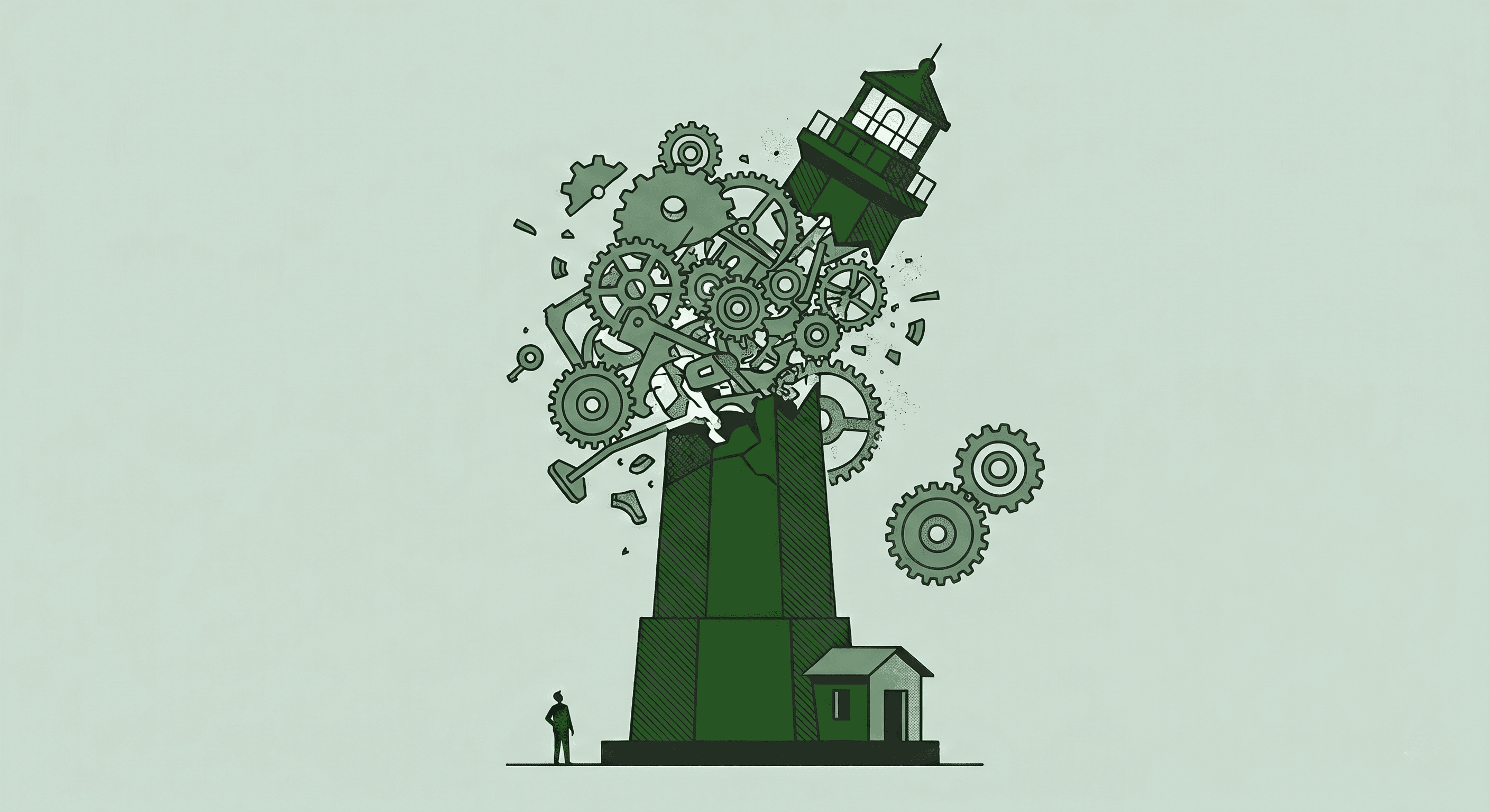
I used to think complex systems and automations were the key to scaling. After working on dozens of Notion projects with both happy and frustrated clients, it became really clear to me.
Simple scales. Complex fails.
People stop using tools when they're complicated and take up more time than they save. Or when they cause more problems than they solve. Complexity is probably the number one reason I've seen clients abandon their Notion workspaces entirely.
The Pattern I See Again and Again
Most teams I've worked with have roughly the same experience. The business is scaling quickly and Notion is the shiny new tool that's going to solve all their growing pains. They download a bunch of templates, maybe one of those "operating system" packages that promises to do everything right out of the box.
They start dumping all their projects, notes, to-do lists, ideas, and documents into the templates with no customization. A couple months go by and the team has 10,000 unorganized pages scattered across a web of databases and relations in a workspace that doesn't make sense for their business.
They wonder why nobody can find anything useful and why the team stopped using Notion. Then they hire someone like me to help sort it out.
This happens because we tend to underestimate the time and effort it takes to adapt to new tools or new ways of working. We assume that more features, more databases, and more automations equal a better system. They don't.
The One Rule That Changed Everything
Lately I've been following one principle on every project. Gall's Law.
Complex systems need to be built on top of already validated simpler systems.
Start simple. Keep it useful, accessible, and intuitive. Every workspace should be created with the idea that each page and block serves a specific purpose, to solve a problem. If it's not helping solve the problem, it shouldn't be there.
This sounds obvious, but it's remarkably hard to follow in practice. The temptation to build something impressive is strong. Dozens of properties on every database. Automations triggering automations. Rollups feeding formulas feeding filtered views. It looks sophisticated. Nobody uses it.
What Simple Actually Looks Like
A simple workspace isn't a bare-bones workspace. It's a focused one.
Simple means every database has a clear purpose and only the properties that people actually use. Simple means navigation is intuitive enough that a new team member can find what they need without a training session. Simple means the system solves real problems without creating new ones.
The goal is finding the simplest, cleanest, easiest solution that actually works. Then once that solution proves itself over weeks and months of real usage, you can start adding the bells and whistles.
This is the part most people get backwards. They add complexity hoping it will solve problems. But complexity added to an unproven foundation just creates more problems to debug.
Why This Matters for Growing Teams
If you're scaling from 10 to 50 employees, your operational systems need to grow with you. Systems that are too complex break under the weight of new users, new use cases, and new edge cases.
Systems that are simple and well-structured adapt. You can add a new database when a new team needs one. You can create a new dashboard when a new function requires visibility. You can layer on automations when manual processes have been proven and refined.
Every layer of complexity you add to a simple, working foundation makes the system stronger. Every layer of complexity you add to an unproven foundation makes the system more fragile.
Start simple. Prove it works. Then build from there.